
Gustav Klimt's Most Expensive Works Sold at Auction
October 14, 2026
Skip to main content
- Home
- ARTnews
- Market
October 12, 2026 5:30am
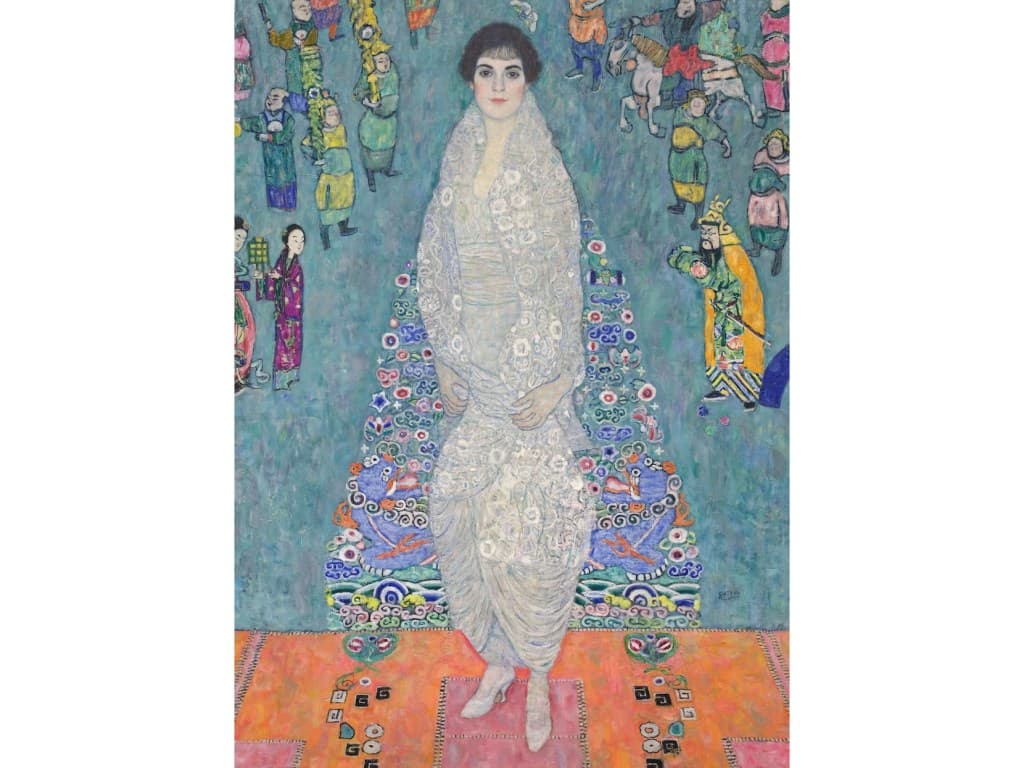
Gustav Klimt, Portrait of Elisabeth Lederer, 1914-1916 Sotheby’s
Over the past several decades, Gustav Klimt has turned into one of the most in-demand names on the international art market, his canvases fetching record prices at auction. Whether it's the gilded elegance seen in his famous portraits or the heavily patterned scenes of Lake Attersee painted during his summer breaks, Klimt's body of work captures the decorative brilliance and artistic innovation that came to define Viennese Modernism. Because collectors prize these pieces for their rarity and lasting appeal, they rank among the most valuable examples of early 20th-century art ever put up for sale.
Klimt's market climbed to unprecedented levels thanks to historic sales such as Lady with a Fan, sold in 2023, along with Blooming Meadow and Portrait of Elisabeth Lederer, both sold in 2025, each confirming how extraordinary the demand for his masterpieces remains. Several of these now rank among the priciest artworks auction houses have ever sold, among them the 10 paintings covered further below.
Landhaus am Attersee (Country House by the Attersee), 1914
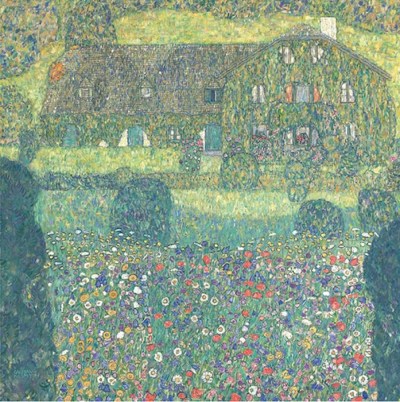
Image Credit: Sotheby’s.
- Landhaus am Attersee (Country House by the Attersee) shows the forester's house situated at the entrance to Austria's Weißenbach Valley, the spot where Gustav Klimt spent his summers on the southern shore of Lake Attersee. It was in this secluded setting, close to members of the Flöge family—including his companion Emilie Flöge—that the artist developed his mature approach to landscape painting. Working in oil on canvas, he turned the modest building and the vegetation surrounding it into a richly patterned composition built from vibrant foliage, vivid color, and mosaic-like brushwork. In contrast to his carefully prepared portraits, Klimt painted his landscapes with few preliminary studies, giving them a stronger sense of immediacy and spontaneity.
- Dating from the last phase of Klimt's Attersee period, the piece reflects his fascination with nature as a space of visual intensity. It was offered at Sotheby's New York on November 5, 2003, carrying an estimate of $18–25 million, and ultimately achieved $29.1 million. That result confirmed the rising appreciation for Klimt's landscapes, works now considered among the artist's most personal and innovative achievements.
Apple Tree I, 1912
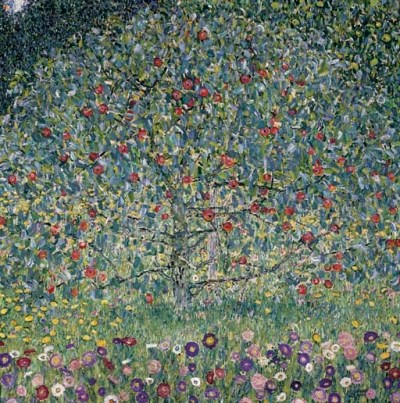
Image Credit: Christie’s.
- Apple Tree I stands as a luminous example of Klimt's mature landscapes, showing a single apple tree rising out of a dense carpet of flowers and foliage. Painted in oil on canvas, it stands out for its vibrant palette, shimmering brushwork, and richly decorative surface, reflecting both Klimt's fascination with nature during his summers at Lake Attersee and the influence of Vincent van Gogh's expressive approach to color and movement.
- The work was first shown at the Große Kunstausstellung in Dresden in 1912, demonstrating Klimt's ability to turn a simple natural motif into a striking decorative composition. Its provenance traces back to Adele and Ferdinand Bloch-Bauer's ownership, followed by restitution to their heirs in 2006. Put up at Christie's New York with an estimate of $15–25 million, Apple Tree I sold for $33 million on November 9 of that same year, a sale that underscored the lasting appeal of Klimt's garden landscapes.
Portrait of Adele Bloch-Bauer II, 1912
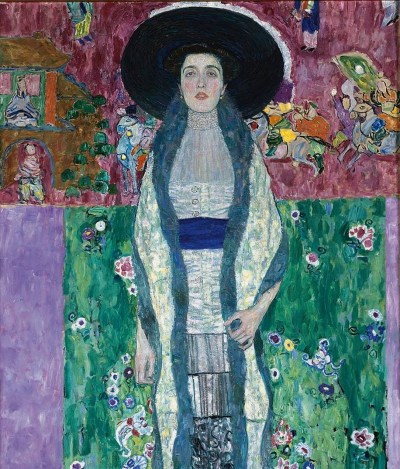
Image Credit: Christie’s.
- Depicting the Viennese socialite and salonnière for whom it is named, Klimt’s Portrait of Adele Bloch-Bauer II is an oil on canvas. Adele Bloch-Bauer was among Klimt’s most important patrons, and she remains the only sitter he portrayed in two separate paintings. The earlier of the two, Portrait of Adele Bloch-Bauer I (1907), now resides at the Neue Galerie New York. The second painting, together with pieces such as Apple Tree I (see above), was once part of the Bloch-Bauer family collection, which Nazi authorities seized following Austria’s annexation in 1938. Following a lengthy legal dispute, the paintings were restored in 2006 to Maria Altmann and the other heirs of Ferdinand Bloch-Bauer, in what became a landmark restitution case.
- That same year, on November 8, Portrait of Adele Bloch-Bauer II went under the hammer at Christie’s New York as part of an Impressionist and Modern Art Evening Sale, fetching $87.9 million and setting a new auction record for Klimt at that point in time. By 2016, the painting’s then-owner, Oprah Winfrey—who had acquired it at Christie’s—sold it privately to an anonymous Chinese buyer for a reported $150 million, marking it as one of the decade’s most notable private art sales.
Birch Forest, 1903
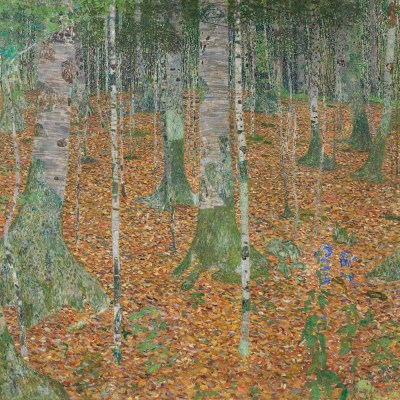
Image Credit: Christie’s.
- “I get up early in the morning, usually around 6 am, sometimes earlier, sometimes later. If I get up and the weather is fine, I go into the nearby forest. I am painting a small beech grove, mixed with a few conifers,” Klimt wrote in an August 1903 letter to M. Zimmerman. His summers spent in Litzlberg, along the shores of Lake Attersee, were when his deep bond with nature took shape. In Birch Forest (Buchenwald), a hidden grove is rendered with great precision. Rising like “columns in a cathedral created by nature,” the slender silver trunks stand out against the dense green foliage, their intricate patterns lending the surface a rich texture.
- Within Klimt’s mature body of work, landscape held an important role, mirroring his pursuit of harmony and visual rhythm. Every tree trunk carries its own distinct markings, revealing the painting’s meticulous detail. Originally acquired by Adele and Ferdinand Bloch-Bauer, Birch Forest was later seized by Nazi forces before being returned to their heirs in 2006; it subsequently appeared twice at Christie’s New York. In November 2006 the work sold for $40.3 million, surpassing its $20−30 million estimate. When it returned to the auction house in 2022 as part of the Paul G. Allen Collection, it brought in $104.6 million, becoming at the time the most expensive Klimt landscape ever sold at auction.
Litzlberg am Attersee (Litzlberg on the Attersee), 1914
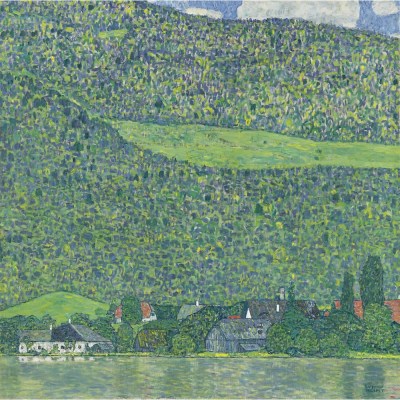
Image Credit: Sotheby’s.
- Litzlberg am Attersee shows the shoreline of Lake Attersee, where houses sit beneath a thickly wooded hillside above a narrow band of water in the foreground. According to recent scholarship, the work was likely completed in the latter half of 1914. Its bold color palette, flattened sense of perspective, and densely layered brushstrokes reflect Klimt’s decorative treatment of landscape. It is thought that the composition drew partly on a postcard photograph of the lake, which the artist had sent to his nephew in August 1914.
- Viennese patrons Viktor and Paula Zuckerkandl acquired the painting directly from Klimt, and it later passed into the collection of Viktor’s sister, Amalie Redlich, a Jewish collector dispossessed after the Nazi annexation of Austria, who was deported to Łódź in 1941. The work spent decades in the collection of the Museum der Moderne Salzburg before being restituted to Redlich’s heir in 2011. It went on to sell for $40.4 million at Sotheby’s New York later that year, exceeding its $25–30 million estimate. Part of the proceeds from the sale went to the Museum der Moderne Salzburg, funding an extension named for Redlich.
Bauerngarten (Flower Garden), 1907
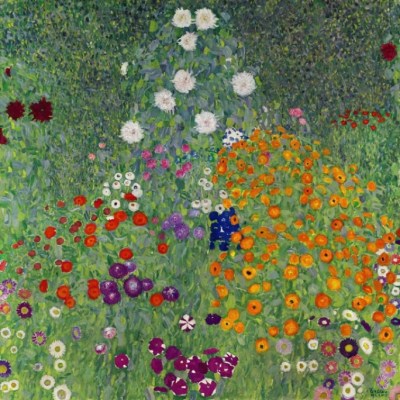
Image Credit: Sotheby’s.
- Among Klimt’s most admired landscapes, Bauerngarten (Blumengarten) (Flower Garden) depicts a loose abundance of poppies, daisies, zinnias, and roses gathered into a dense array of color and pattern. The oil on canvas reflects Klimt’s summers spent at Lake Attersee and his developing approach to landscape painting, grounded in the symbolic aims of the Viennese avant-garde. Created in the garden of the Mayr-Hof, his summer retreat in Litzlberg, it reveals how nature and decoration merged in his work.
- The painting debuted at the Kunstschau in Vienna in 1908, drawing notice for its unconventional composition and near-mystical rendering of nature. At Sotheby’s London in 2017, with an estimate topping $45 million, Bauerngarten fetched roughly $59.3 million, making it at the time the priciest Klimt landscape ever to sell at auction. The sale highlighted how rarely significant Klimt landscapes come to market, given that most works of such stature remain in museum holdings.
Portrait of Fräulein Lieser, 1918
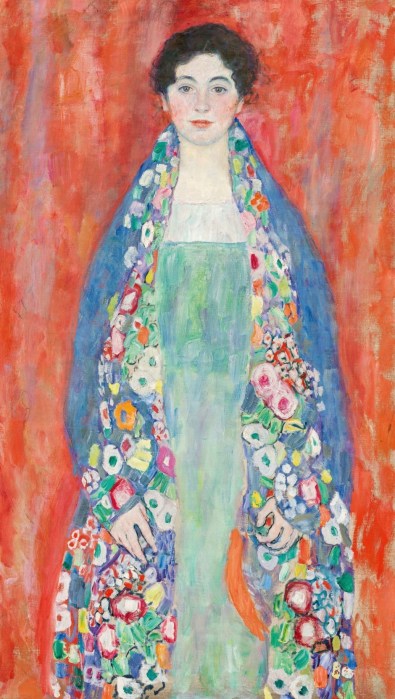
Image Credit: Wikimedia Commons.
- Seated frontally against a vivid red backdrop, a young woman wears a cape patterned with flowers. Her face shows delicate, precise detailing that sits in contrast with the freer, more expressive brushstrokes typical of Klimt’s late period. Who she was remains unsettled. Earlier catalogues named her as Margarethe Constance Lieser (1899−1965), though newer research points to either Helene Lieser (1898−1962) or Annie Lieser (1901−1972), both daughters of Viennese patrons Henriette and Justus Lieser. Klimt took up the portrait in 1917, and the model came to his Hietzing studio nine times across April and May of that year. The piece remained incomplete at his death from a stroke on February 6, 1918.
- For decades, the painting's location was unknown to scholars, who knew it only from a black-and-white photograph, until it surfaced in the hands of an Austrian private owner. Vienna’s im Kinsky—Austria’s second-largest auction house, known for its Klimt expertise and track record with restitution-related sales—auctioned it on April 24, 2024. Including fees, Portrait of Fräulein Lieser sold for approximately $41 million, becoming the highest price ever paid for an artwork at auction in Austria. The owners at the time and the legal successors of the Liester family authorized the sale, following an agreement grounded in the 1998 Washington Principles. Patti Wong & Associates purchased the work on behalf of an anonymous buyer.
Dame mit Fächer (Lady with a Fan), 1917−1918

Image Credit: Sotheby’s.
- Believed to be the final portrait Klimt worked on before dying in 1918, Dame mit Fächer remained on the easel in his Vienna studio at the time of his death. It stands as the high point of the artist’s late portrait work, merging the unidentified sitter’s human presence with the elaborate patterning and decorative invention that marked his final years. Klimt returned to the square format he had first used in Portrait of Sonja Knips (1898), centering the figure within the composition and surrounding her with Asian-inspired motifs such as the phoenix and lotus blossoms. The sitter’s ornate robe also reflects Klimt’s longtime fascination with textiles and fashion, an interest tied closely to his companion Emilie Flöge, an influential Viennese fashion designer.
- In June 2023 at Sotheby’s London, Dame mit Fächer carried a third-party guarantee and an estimate exceeding £65 million ($80 million). It hammered at $93.5 million and reached $108.4 million with fees, setting a new auction record for Klimt. This surpassed the earlier record of $104.6 million set by Birch Forest, underscoring the intense demand for Klimt’s late masterpieces within the international market.
Blumenwiese (Blooming Meadow), 1908
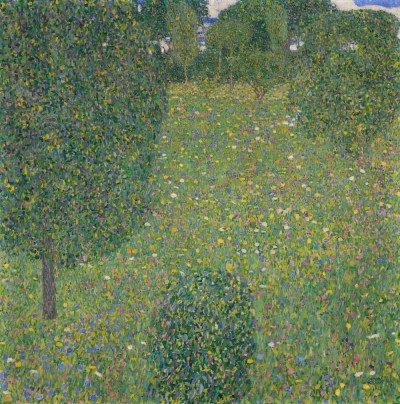
Image Credit: Sotheby’s.
- Depicting the meadows around Lake Attersee, Klimt departs from a conventional landscape format, instead presenting a vivid carpet of wildflowers—bellflowers buttercups, daisies, cornflowers, clover, and dandelions—that covers the entire canvas. The horizonless view, square composition, and flattened pictorial space reveal the influence here of late Claude Monet, Japanese art, and emerging Modernist photography.
- Likely painted in the summer of 1908, Blumenwiese marks a turning point in Klimt’s landscape work, as he drove the genre toward greater abstraction. So unconventional was the composition that some critics of the time dismissed Klimt’s style as the work of a “madman.” The painting's historical significance is further heightened by its distinguished provenance, which includes ownership by Austro-Galician painter Broncia Koller-Pinell and her husband, Hugo Koller. At Sotheby’s in 2025, the painting sold for $86 million (including fees), making it the second-most expensive Klimt landscape ever auctioned and confirming its rarity and lasting appeal among collectors.
Portrait of Elisabeth Lederer, 1914-1916
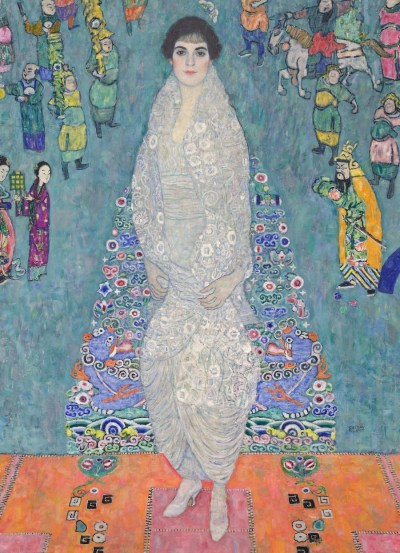
Image Credit: Sotheby’s.
- Klimt's mature portrait style is exemplified by Portrait of Elisabeth Lederer (1914−16), where decoration and realism meet seamlessly. From an elaborate costume that blurs the boundary between figure and background, the subject emerges. Nearly three years of revisions went into completing the painting, which demonstrates Klimt's meticulous working process and extraordinary feeling for ornamentation.
- The painting, commissioned by the Lederer family, among Klimt's most important patrons, is one of only two full-length portraits by the artist remaining in private hands. During the Second World War it survived Nazi confiscation, being restituted in 1948. Its provenance, which later included a time in the collection of Leonard A. Lauder, makes it one of Klimt's most significant surviving mature portraits. The painting, estimated at $150 million, was the centerpiece of Sotheby's November 2025 sales. Following a dramatic 20-minute contest between two telephone bidders, $236.4 million (including fees) was realized, eclipsing Klimt's previous record and making it the second-most expensive work ever sold at auction, behind Leonardo da Vinci's Salvator Mundi.