
Christie's Achieves $145.9 Million 21st-Century Art Sale Led by $32.9 Million Basquiat Amid Softening Market
November 20, 2026
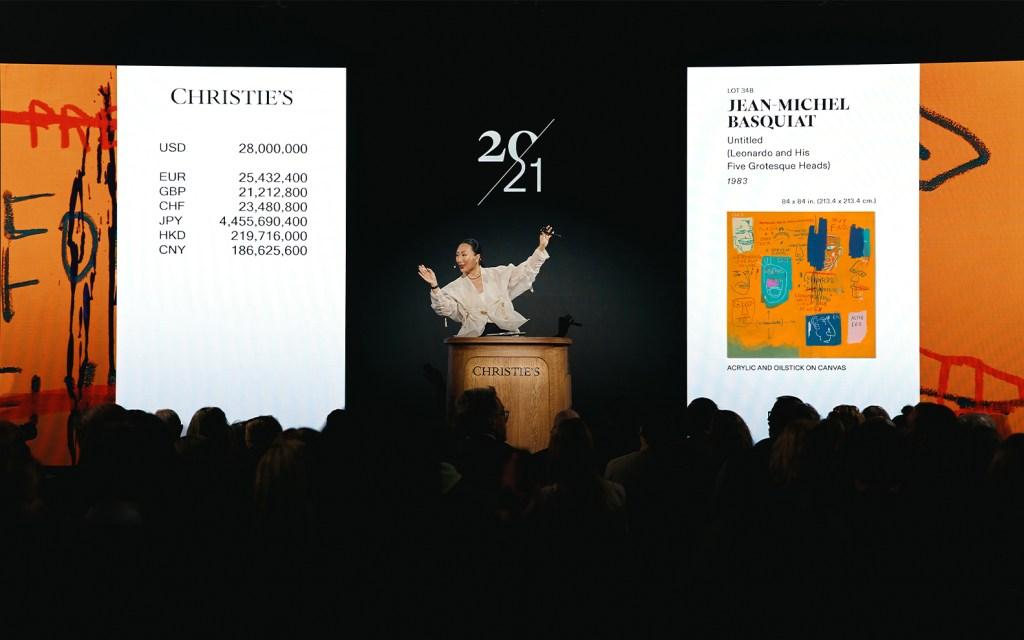
On Thursday evening, Christie’s wrapped up New York’s fall auction week at its Rockefeller Center salesroom, pulling in $145.9 million from a 56-lot sale of 21st-century art (this came after works by Jeff Koons and Ed Ruscha, together estimated at as much as $11 million, were pulled from the sale). Topping the sale was a Jean-Michel Basquiat painting that sold for $32.9 million, just under its low estimate.
Among the lots were 20 works coming from the collection of Antonio Homem, who has long served as director of the storied Sonnabend Gallery, founded by his adoptive mother, Ileana Sonnabend. These works, sold for the benefit of their foundation, brought in a combined $41.9 million. The sale also featured 10 works from the estate of the late New York philanthropist Agnes Gund, who passed away last year, which together totaled $25.7 million.
Related Articles
Following the withdrawals, estimates for the sale ranged from $126 million to $192 million; however, the night's hammer total landed well below that range, at $117.7 million. Across the two-hour sale, buyers were found for 51 of the lots, putting the sell-through rate at 91 percent. Pieces by John Currin, William Eggleston, Wade Guyton, Gerhard Richter, and Yayoi Kusama did not find buyers.
The room held many well-known advisors, among them Erica Barrish, Amy Cappellazzo, Ralph DeLuca, and Gabriela Palmieri, along with recognized dealers such as Marianne Boesky, Jeanne Greenberg Rohatyn, and Christophe Van de Weghe. Still, a fair number of seats sat empty, and after a long week of sales, the mood was clearly drained.
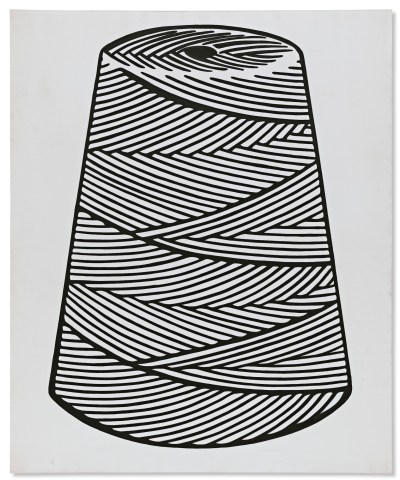
Roy Lichtenstein, Large Spool (1963).
Things got off to a rough start, as none of the first 19 lots—all part of the Sonnabend collection—hammered above estimate. Only on the trove's last lot, Jean Prouvé's Table “Centrale” (“Trapèze”), petit modèle, did bidding gain momentum. After five minutes of back-and-forth among multiple specialists and someone bidding in person, Sara Friedlander, who chairs Christie's postwar and contemporary art department in the Americas, secured the piece for $1.3 million on the hammer. Once fees were added, the price reached $1.7 million, against an estimate of $700,000–$1 million. Even so, half of the 20 Sonnabend lots—10 in total—sold below their estimates. In the end, the collection brought in $33.4 million at hammer, or $41.9 million including fees, falling short of the $35.25 million to $53.15 million pre-sale estimate (with Koons's Wild Boy and Puppy having been pulled from the sale). However you look at it, it wasn't a strong outcome.
Chief among the Sonnabend works was Andy Warhol’s 1962 painting Campbell’s Soup Can (Turkey Noodle), carrying an estimate of $6–$8 million. The soup cans depict one of Warhol’s most recognizable images and are nearly synonymous with Pop art itself. Adrien Meyer, global head of private sales and the auctioneer for Tuesday evening’s 20th-century sale, went back and forth with a bidder in the room, who ultimately secured it with a bid of $7.3 million, amounting to $9 million once fees were included.
The trove also included Roy Lichtenstein’s Large Spool (1963). The piece, standing nearly six feet high, hadn’t been on the market since the Sonnabends purchased it from Leo Castelli Gallery four years after it was painted. Museums around the world have displayed it, and its sale now coincides with a major Lichtenstein retrospective at New York’s Whitney Museum of American Art. From the rostrum, auctioneer Yu-Ge Wang fielded a handful of absentee bids before Friedlander secured it for her client with a $7 million bid, bringing the total to $8.6 million with fees. The pre-sale estimate had been $10 million to $15 million.
Jeff Koons's six-foot-high sculpture Hulk (Friends), 2004–12, also from the Sonnabend collection, depicts the comic-book character accompanied by tiny creatures sitting atop its shoulders, carrying an estimate of $3.5–$5.5 million. After just a handful of bids, it sold for $3.3 million, or $4.15 million including fees, going to the house's Michael Baptist. (Koons also sold this week, consigning seven artworks to Christie's Tuesday night sale, which totaled $104 million.)
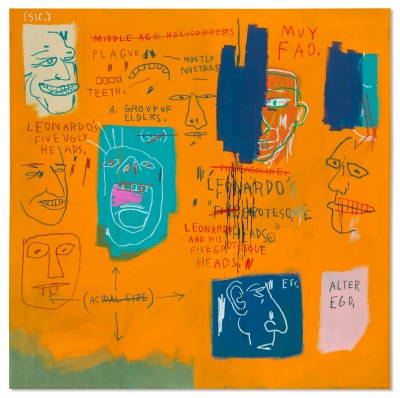
Jean-Michel Basquiat,’ Untitled (Leonardo and His Five Grotesque Heads)’, 1983 Courtesy Christie’s
From that point, bidding picked up slightly, though overall the sale lacked energy. Even the evening’s headline lot, Basquiat’s widely discussed Untitled (Leonardo and His Five Grotesque Heads), a seven-foot-square work from 1983, struggled to spark real enthusiasm. Wang launched bidding at $23 million, and the room stayed quiet for what felt like a long stretch. Eventually Ana Maria Celis, head of postwar and contemporary art, stepped in and outbid Alex Rotter, who serves as Christie’s global president and global chairman of 20th- and 21st-century art. The hammer fell at $28 million, bringing the final price with fees to $32.9 million.
At roughly $30–$50 million, the hammer price landed just under the low end of what had been projected. Yet the piece, drawing on a Leonardo da Vinci sketch, hadn't appeared at auction in twenty years, meaning its seller almost certainly walked away with a solid gain. It's well known that the market for this painter has surged since then: all 83 of his works that have ever crossed $10 million at auction have done so within that span.
The large canvas, marked by the artist's characteristic scrawled phrases and the sketchy heads named in its title, set against an orange background, had risen sharply in value since its earlier appearances at auction. It first came up at Sotheby's London in 2000, selling for just over $400,000, within its estimate, then returned to the same house five years later, where its price tripled to $1.3 million, exceeding estimate.
Untitled (Ocean), a 1990 painting by Vija Celmins, stood out as one of the night's rare lots to spark real competition between bidders. It had come from the Gund estate, with Gund having purchased it a year after its completion. Bidders included Joanna Szymkowiak, head of private sales; Arco Yu, a Christie’s Hong Kong specialist; plus someone bidding from the room. Over four minutes, bids went back and forth among the three until the person in the room ultimately prevailed. Even so, the hammer price reached just $5.75 million, falling short of the $6 million low estimate. Once fees were added, the total climbed to $7.1 million.
Compared to the Sonnabend collection pieces, the 10 Gund works performed better, hammering at $20.4 million against a pre-sale estimate of $16.95 million to $24.65 million. Once fees were added, the total edged just above the high estimate, landing at $25.7 million.
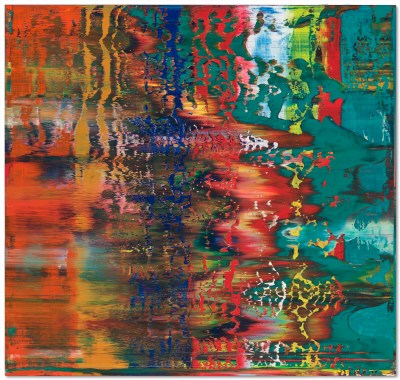
Gerhard Richter, Abstraktes Bild (1991).
The proceedings lacked momentum. An Abstraktes Bild from 1990 by Gerhard Richter, consigned from the estate of Marian Goodman—the influential dealer who represented him for years and acquired this piece directly from the artist in that same year—carried a $6 million to $8 million estimate but drew no bids and went unsold. Three lots afterward, a second Abstraktes Bild, this one from 1991 and measuring three feet square with red, blue, and green dominating the canvas, prompted a brief back-and-forth between Friedlander and Rotter. Rotter ultimately secured it for $7.6 million, bringing the total with fees to $9.4 million, against a pre-sale estimate of $7 million to $10 million.
“The estimates were too high for this market,” Greenberg Rohatyn told ARTnews as she left the salesroom partway through the night. “We need to readjust, and the houses need to be at the forefront of managing expectations.”
Boesky likewise felt the estimates had been set too high. “And the energy was low,” she remarked on her way out. “The lots that were estimated too high were punished, and those estimated low were rewarded.”
On a more positive note, several records were set: Jim Nutt ($1.1 million), Antonio Santín ($486,400), and Julia Jo ($409,600).
Closing out the night was The Jo, a gestural, swirling composition where fiery oranges and yellows collide with cool blues and teals, carrying an estimate of $30,000–$50,000. Benefiting the Coalition for the Homeless, this piece drew what was perhaps the evening's liveliest bidding. Wang started the bidding at $20,000, and the price soon surged into the hundreds of thousands as specialists and a room bidder traded calls back and forth. The room bidder ultimately secured it, with the hammer falling at $320,000—totaling $403,200 once fees were added. The moment drew enthusiastic applause, if only for that single lot.
This sale brought to a close an auction week that began Monday, when Sotheby’s held a two-part sale totaling $378.7 million, featuring works from cable television magnate Ted Baum and interior designer Ruth Baum alongside a various-owner The Now and Contemporary sale. On Tuesday, Christie’s ran a nearly three-hour 20th-century sale that reached $626.6 million in total, topped by an $85.8 million abstraction by Wassily Kandinsky that set a record, with an $82.3 million landscape by Gustav Klimt close behind. That same evening, Phillips brought in $104.4 million from its modern and contemporary art sale, topped by a $44.6 million sculpture by Amedeo Modigliani. Then on Wednesday, Sotheby’s held an Impressionist and modern art sale totaling $777.8 million, topped by a Vincent van Gogh that set a record at $190.4 million.