
Down the Rabbit Hole on Park Avenue
September 18, 2026 · John Enot
Photographs by Bridgett Ezzard (@bephoto)
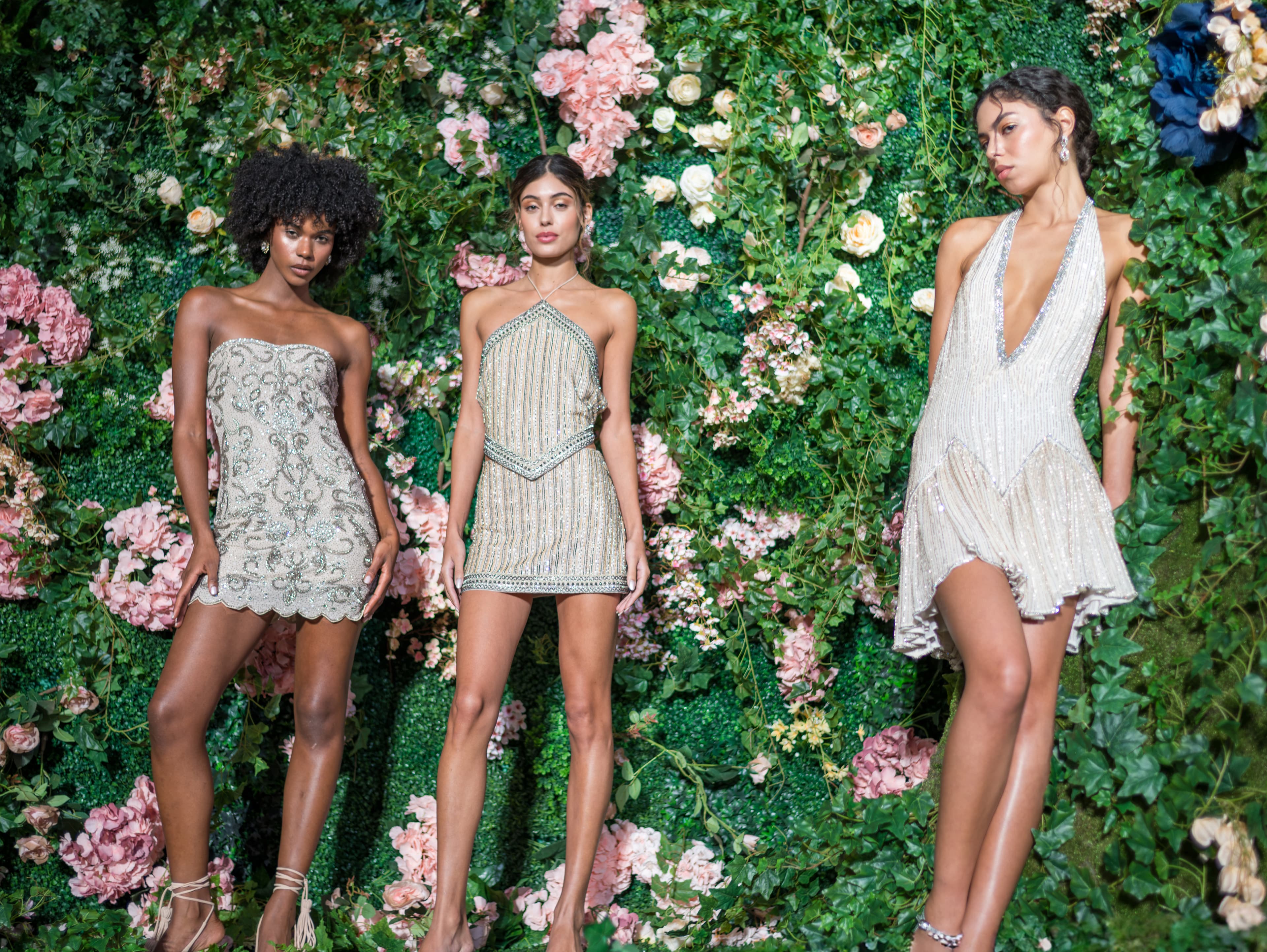
There is a particular kind of New York woman who has never met an embellishment she didn't like, who believes a bow is not a decision but a philosophy, and who has, for two decades now, found her uniform inside a label called Alice + Olivia. On September 10th, on Park Avenue, that woman's patron saint — a five-foot-two Chappaqua-raised, University of Pennsylvania-educated dynamo named Stacey Bendet — sent her down a rabbit hole entirely of her own devising. "Welcome to Wonderland," the invitation read, and it was not, it turned out, a metaphor deployed lightly.
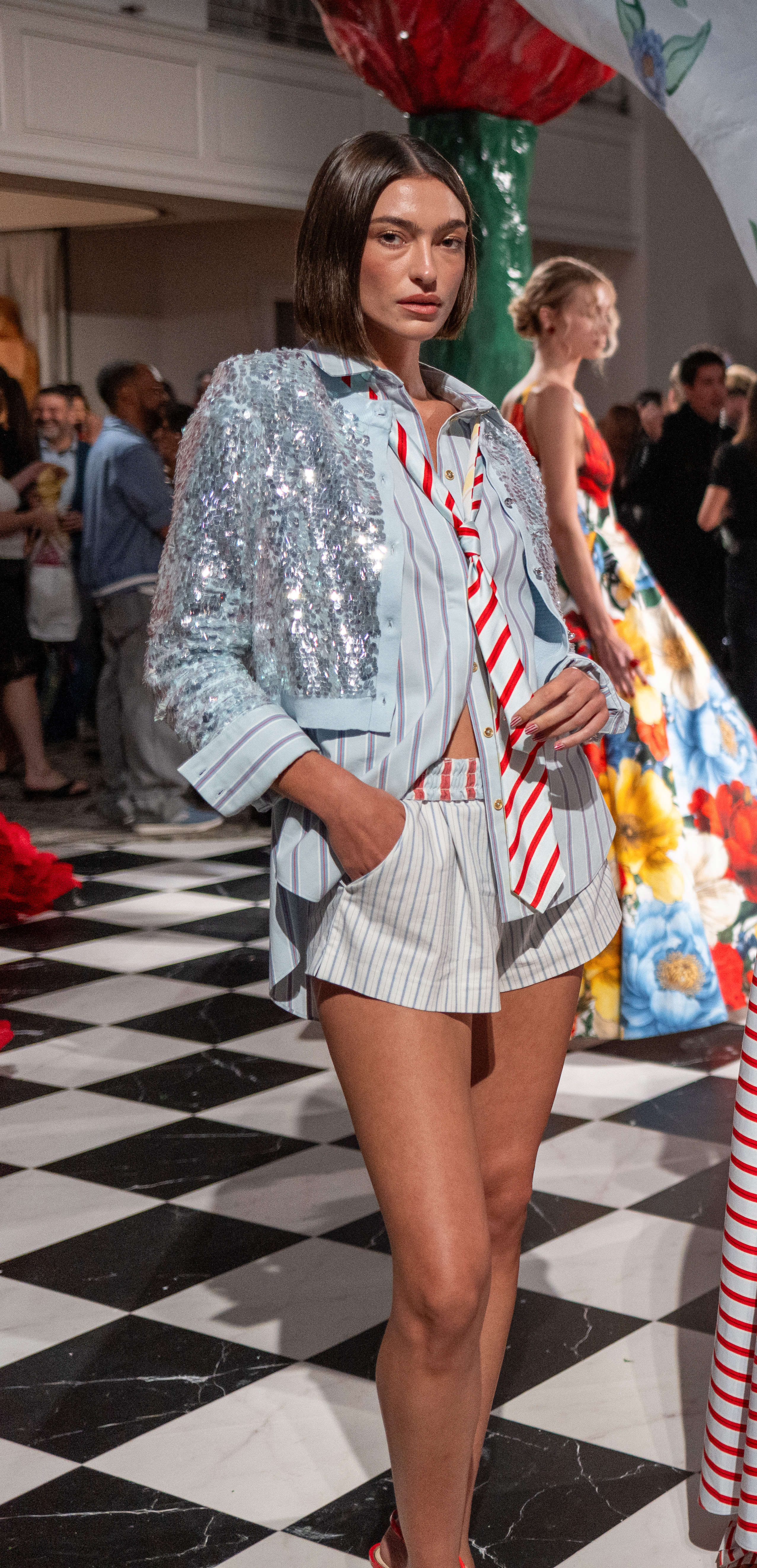
For her Spring/Summer 2027 presentation, staged inside 583 Park Avenue rather than on a runway proper, Bendet did not so much reference Lewis Carroll as commandeer him, tumbling headfirst into his looking-glass logic and dragging half of boldface-name New York in after her: Paris Hilton, Tiffany Haddish, and Jessica Alba were among the guests who arrived to find the brand's twenty-fifth-adjacent chapter written in lace, organza, metallic jacquard, iridescent sequin, satin, and feather, rendered in a palette of soft pink, lavender, pale blue, yellow, and white — a Wonderland, notably, with better tailoring than Carroll's.
A Wonderland, Built to Scale
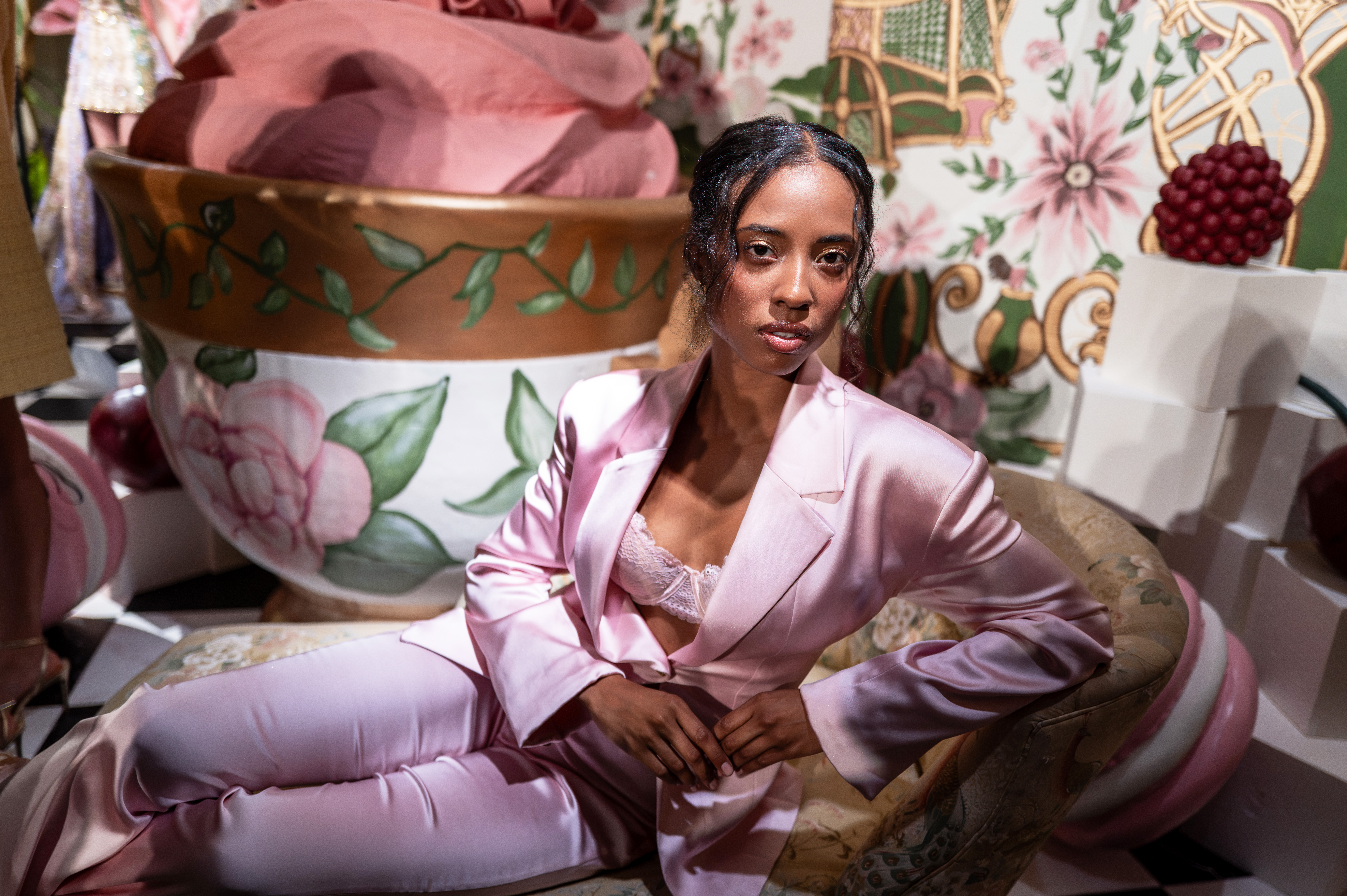
Bendet's team did not so much decorate the room as re-engineer it. A soft-serve swirl the size of a doorway rose out of a bed of oversized berries; a hand-painted clock face big enough to have its own gravity kept time behind the receiving line; a chinoiserie cabinet, guarded by an ivory rabbit sculpture twice its own height, held teacups scaled for no one's actual hands. It was the kind of set dressing that usually stays backstage, pulled, for one afternoon, all the way into the room — giving even the collection's quietest, most intimate look, a pale pink satin pajama suit, a genuinely theatrical stage to be photographed on.
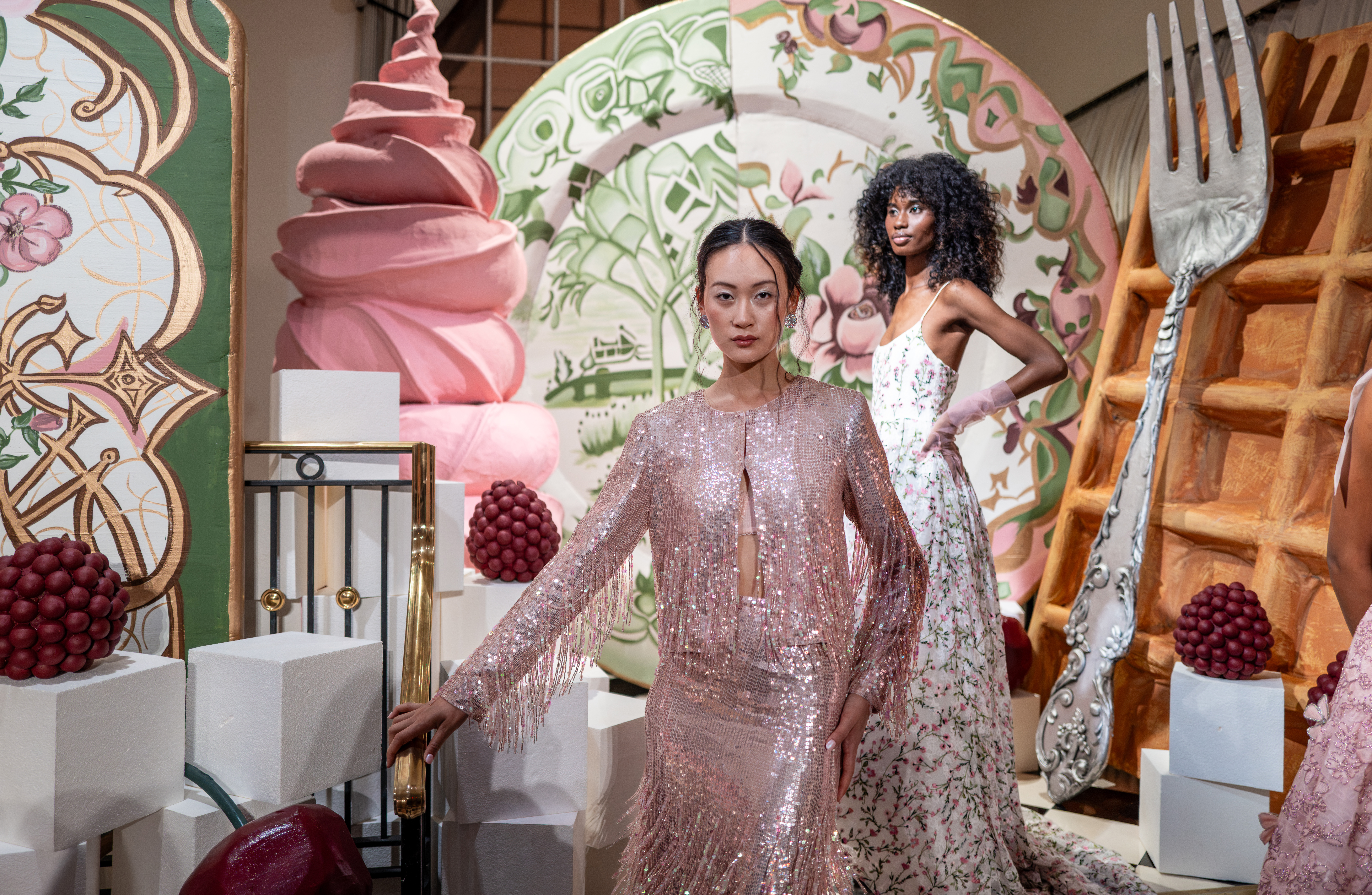
The candy logic scaled up considerably elsewhere in the room, where two more looks — a sequined fringe caftan and a floral spaghetti-strap gown — posed beside a soft-serve sculpture the size of a phone booth and a silver fork long enough to vault, the whole tableau staged like an edible diorama built at three times human scale.
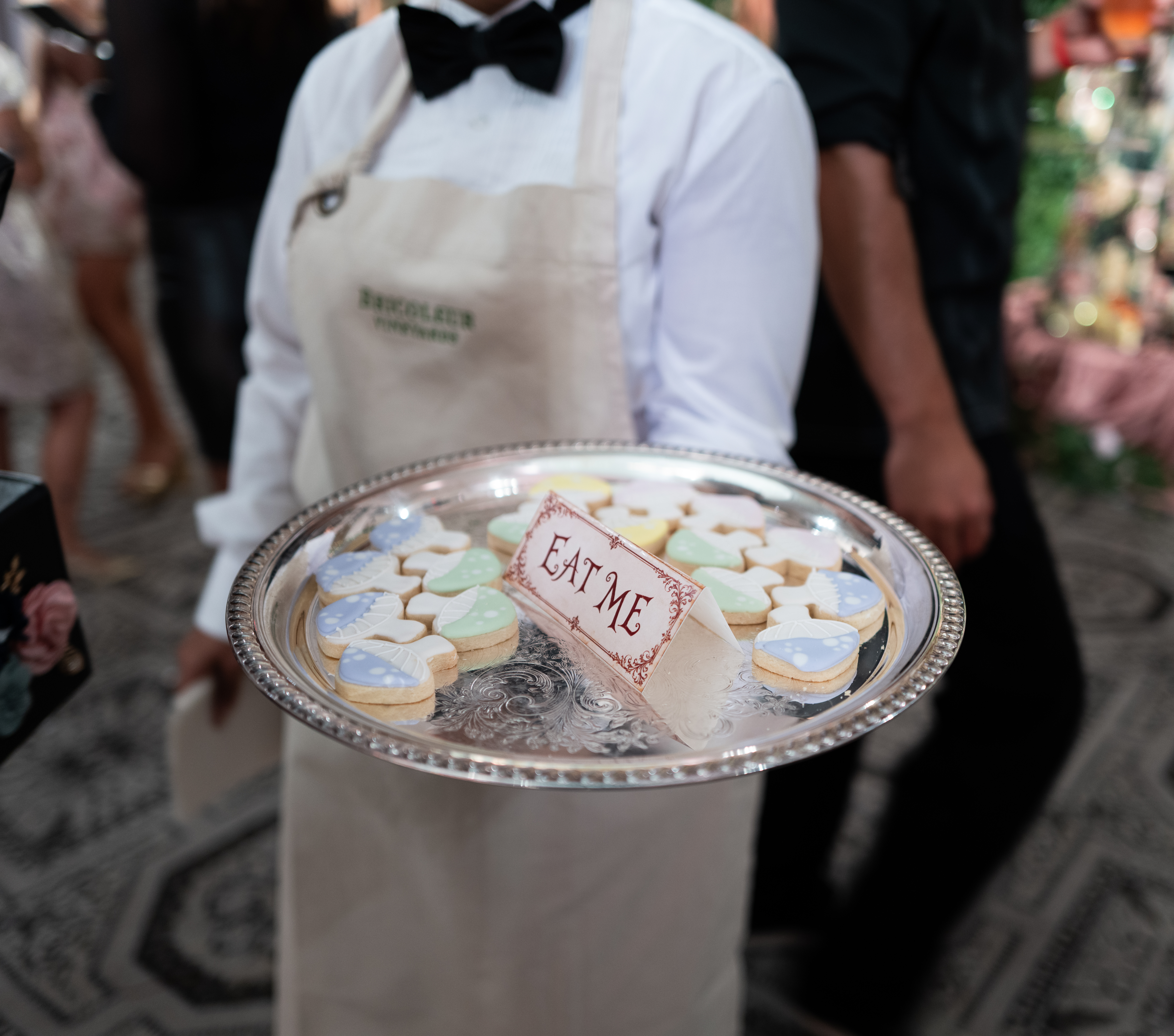
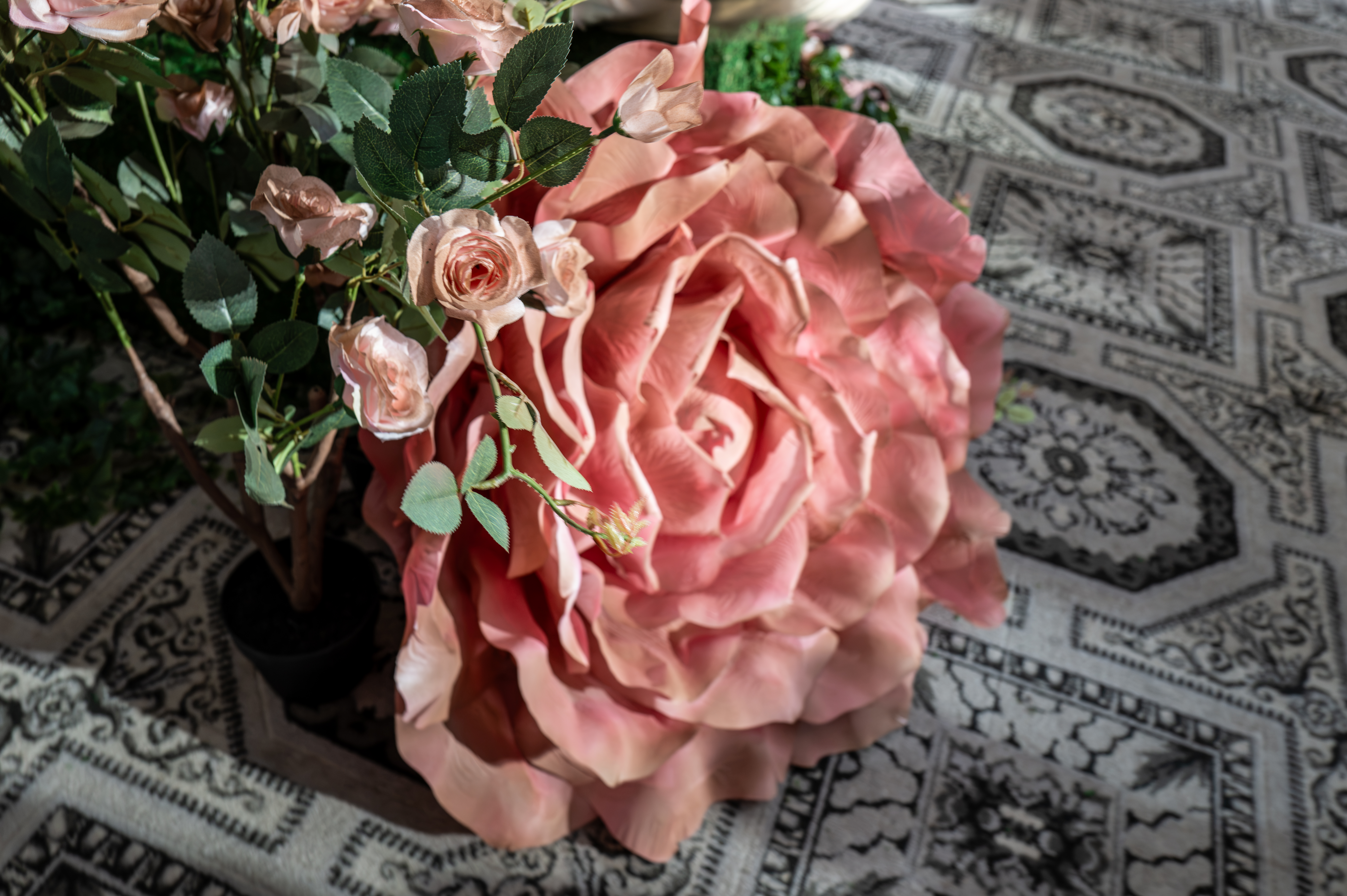
Even the smaller props were in on the joke: waiters wound through the crowd bearing silver trays of pastel-iced cookies stamped EAT ME — Carroll's own stage direction, borrowed wholesale — while a single rose nearby, cut at Brobdingnagian scale, sat propped on the same patterned runner the guests had just walked in on, too large to be anything but a punchline dressed as a centerpiece. Next to the room's actual showstoppers, both were content to stay exactly that size.
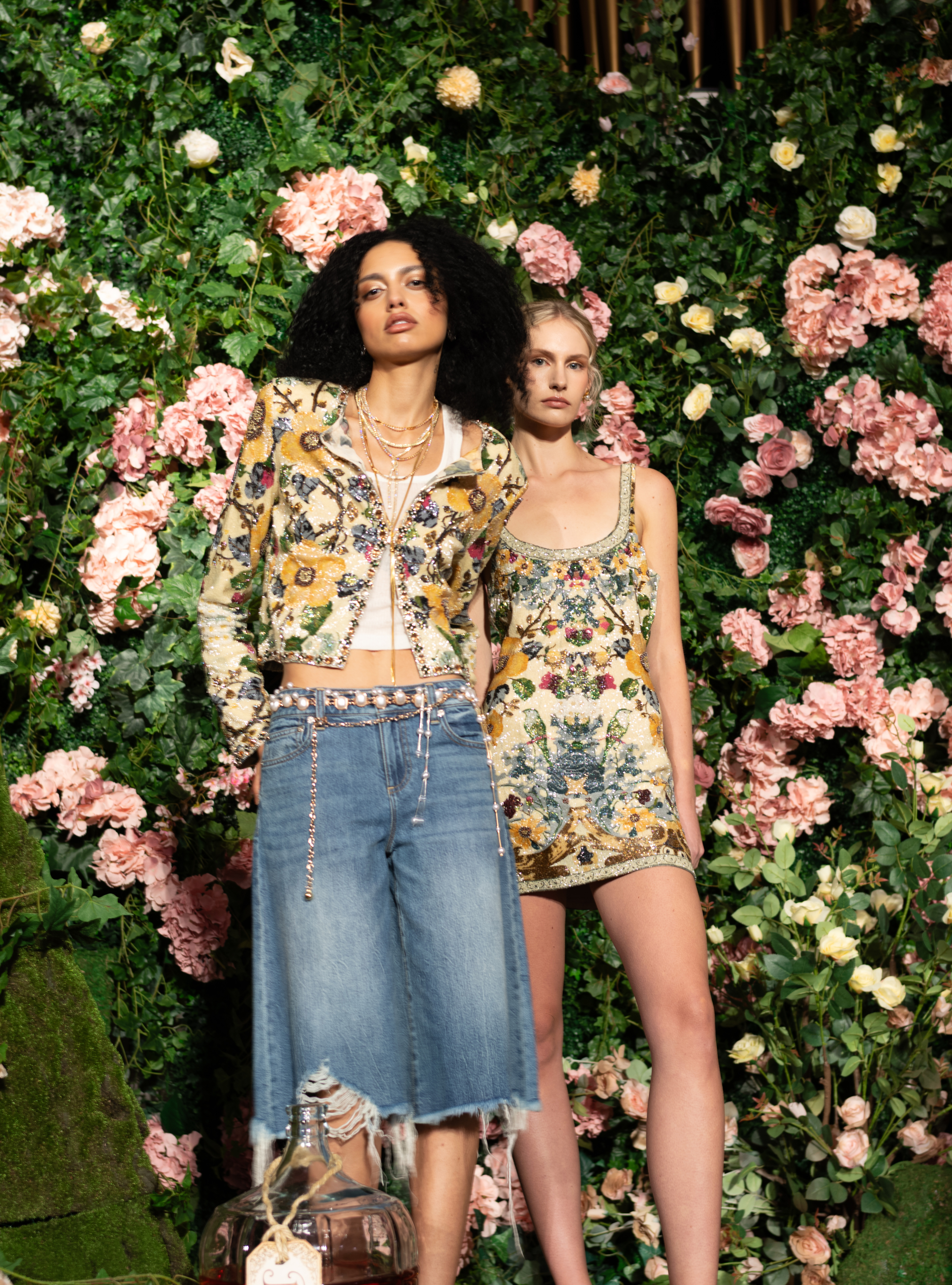
Bendet has taken to calling the collection's central idea "preppy couture," a phrase that sounds, at first pass, like a contradiction of terms — the loafer-and-headband ease of American sportswear grafted onto the labor-intensive embellishment of a couture atelier. But the contradiction is the point, and it has been the point since 2002, when Bendet, not yet twenty-five, launched the label with co-founder Rebecca Matchett on the strength of a single, almost absurdly narrow idea: pants. Twenty of them, low-rise and slim through the leg, cut in colors and patterns that had no business being called basics, debuted at a presentation inside the Russian Tea Room and shortly thereafter landed at Barneys.
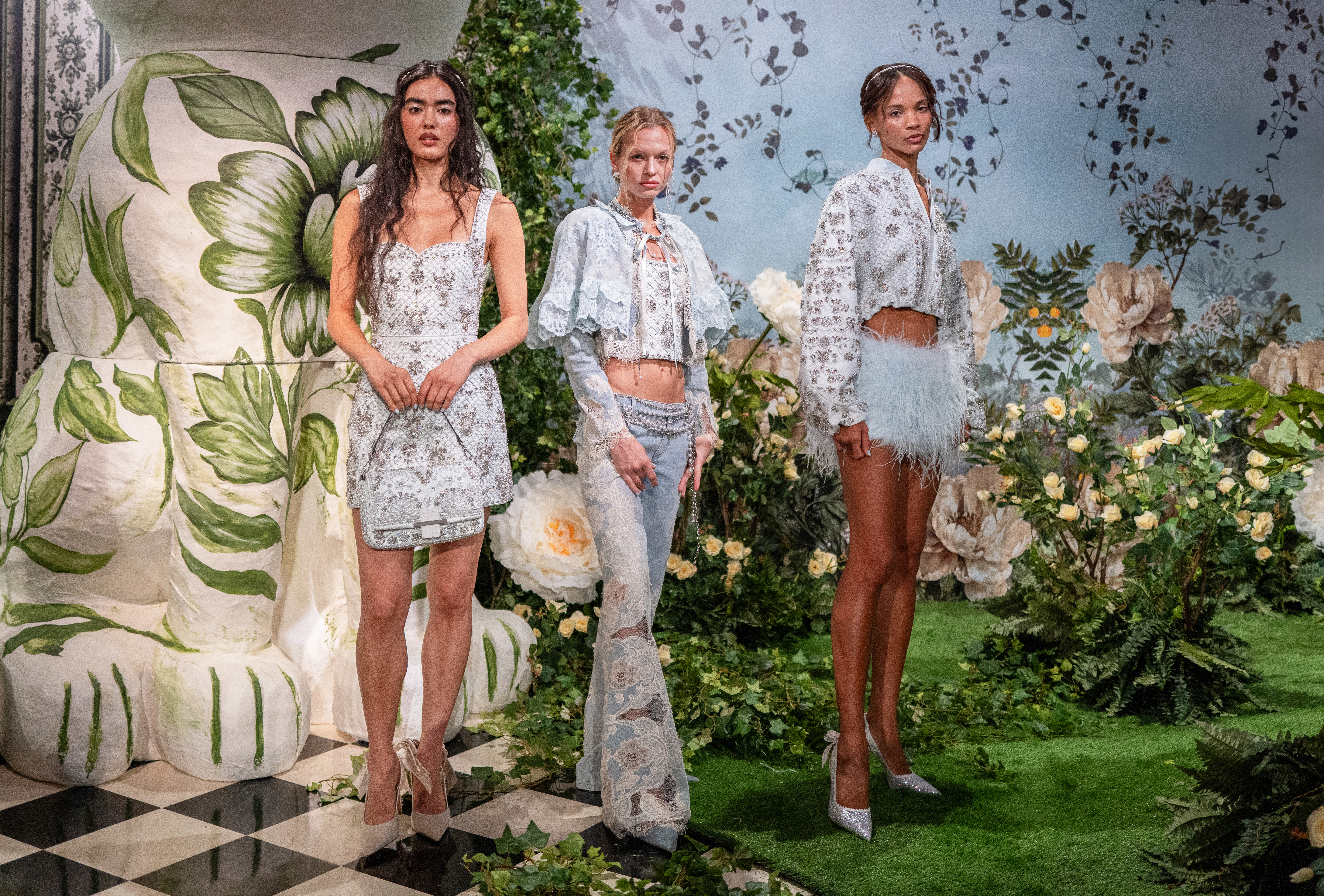
The idea repeated itself throughout the collection in different registers: a crystal-beaded bomber jacket cropped above an ostrich-feather micro skirt, worn with the same unbothered ease as a cardigan and jeans; a few looks later, the same feathered hemline reappeared on a third model, flanked by a crystal-mesh mini dress and a lace-and-denim pantsuit, the trio reading like three different answers to the same assignment.
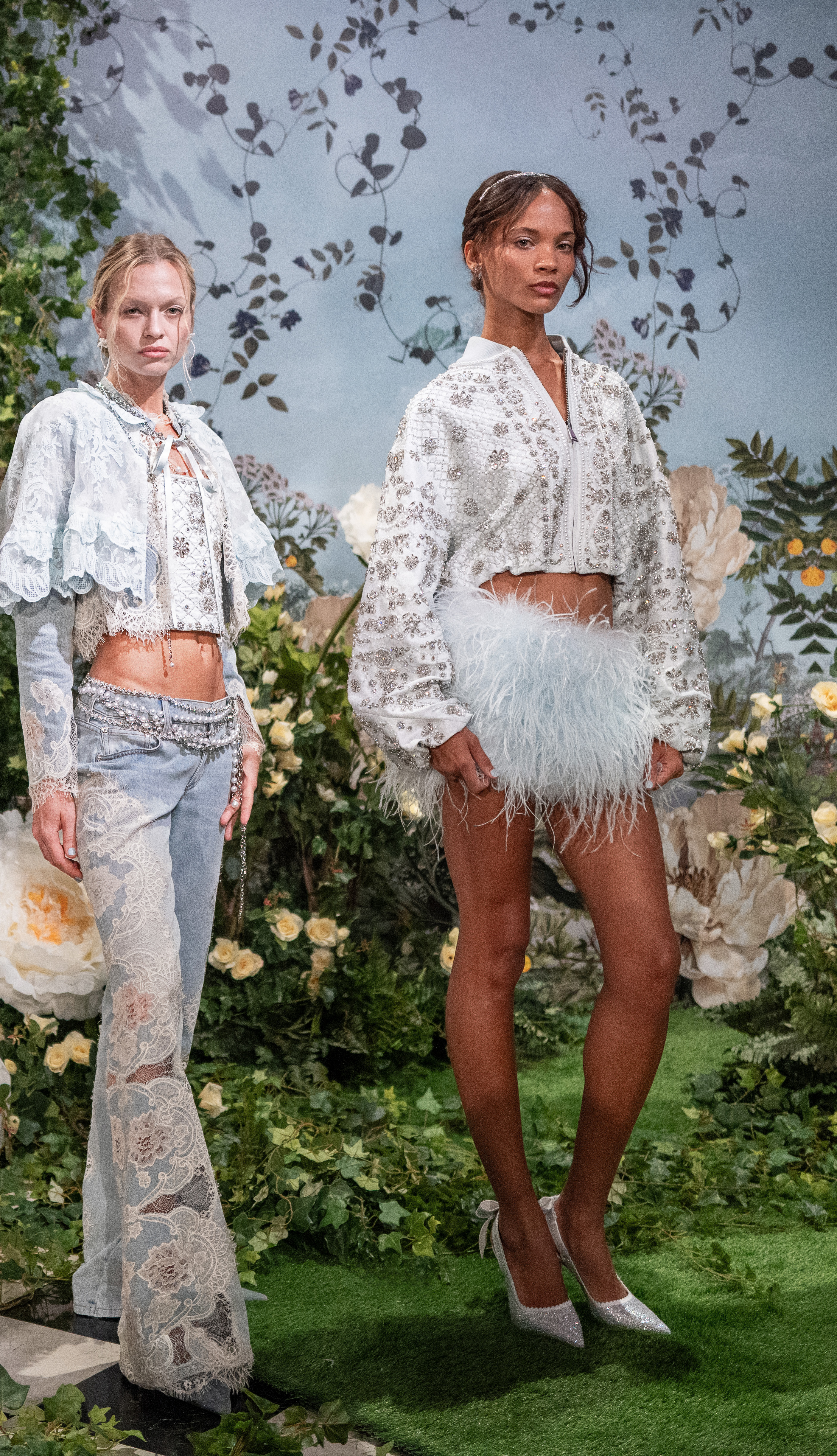
Seen together — the pair above, and the trio below — all three registered less like separate looks than a single thesis restated three times, each one arguing the same case in a slightly different accent. It was a small bet on the theory that even a trouser, the most utilitarian garment in a woman's closet, could be made to perform. Two decades on, that bet has paid out into a brand sold in more than fifty countries, with thirty-five freestanding American boutiques and an outpost in nearly every department store that matters, from Hong Kong to Dubai to Dallas.
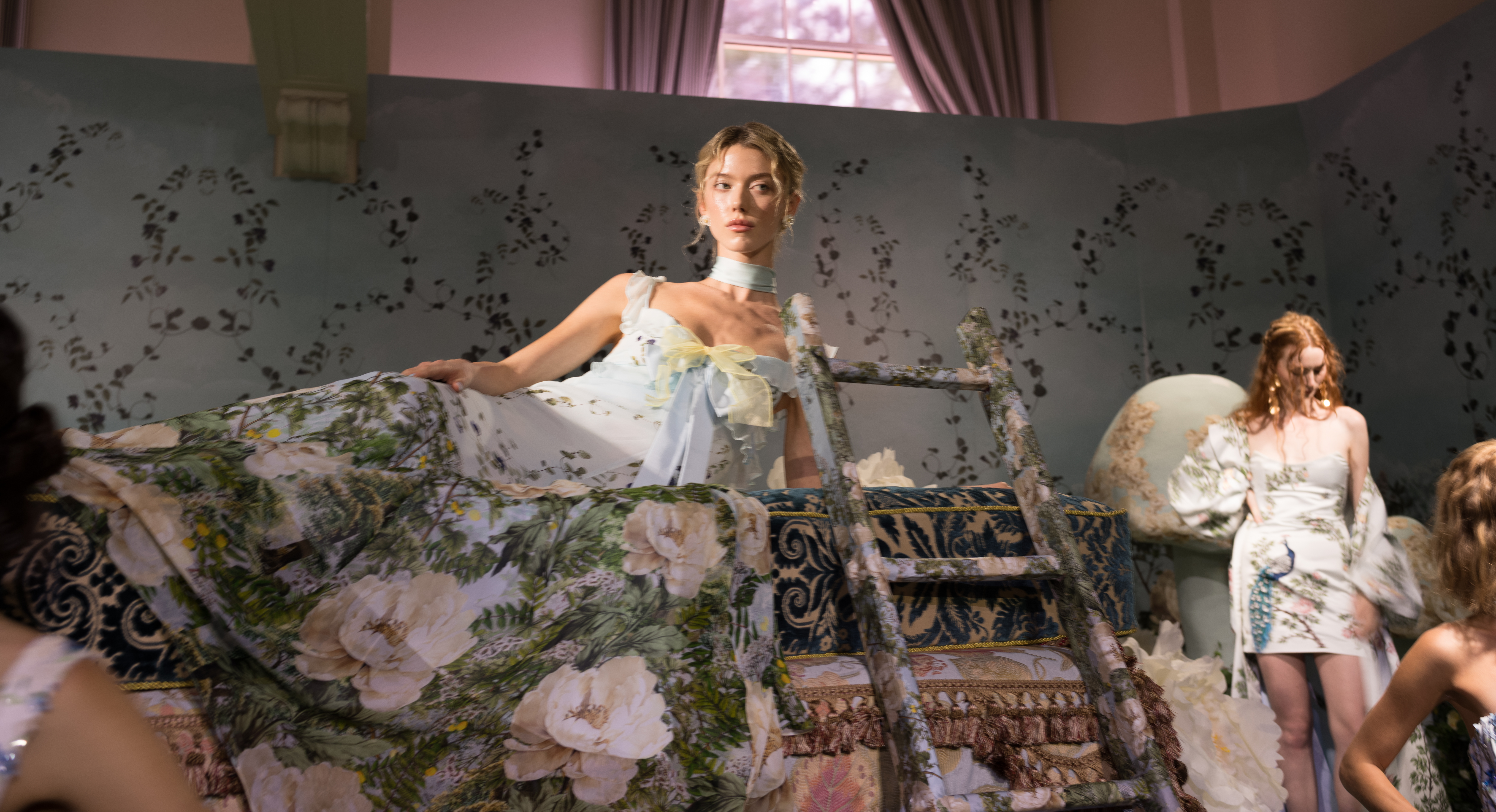
Backstage — or what passed for backstage, since Bendet's Wonderland dissolved the line between the two — a model draped herself across an antique settee reupholstered in the collection's own floral chintz, catching a quiet moment before stepping out in the pale blue, bow-tied gown she'd wear to the room twenty minutes later, the hush of it a deliberate contrast to everything performing itself just beyond the curtain.
What has stayed constant across two decades is less a silhouette than a sensibility — what Bendet describes, when pressed to name it, as "bohemian-prep meets downtown romantic," a description that undersells how thoroughly she has built an entire design language out of refusing to choose. Alice + Olivia clothes flirt and cover their tracks in the same breath: sexy and sophisticated, whimsical and exacting, a party dress that has clearly done its homework. Bendet, who has said she believes a woman's clothes "should tell the story of who you are and who you want to be," treats every collection less as a product line than as a piece of world-building, complete with a title, a mood, and — increasingly — a stage set, like the pale blue gown below wore out of that same backstage settee.
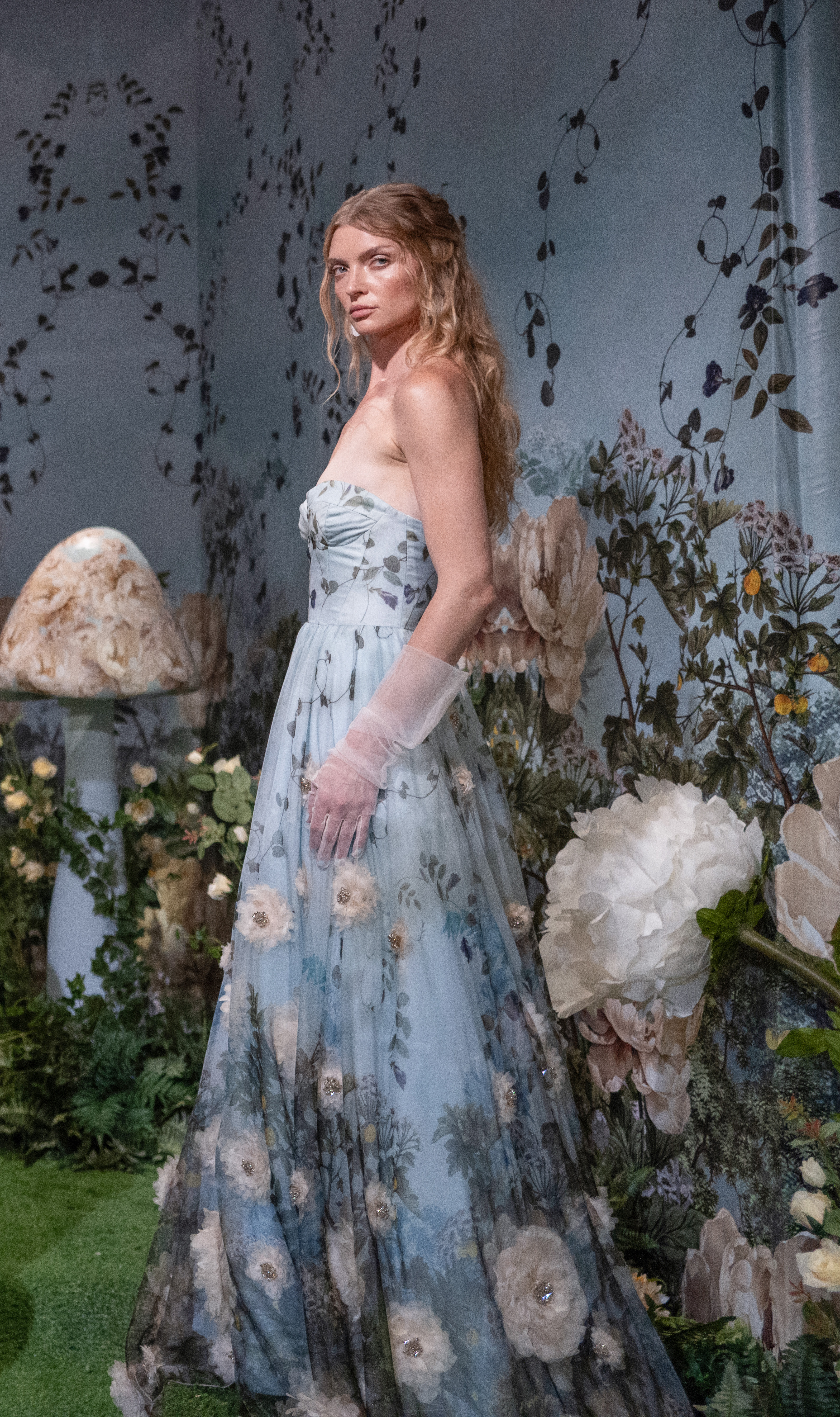
Bohemian-Prep Meets Downtown Romantic
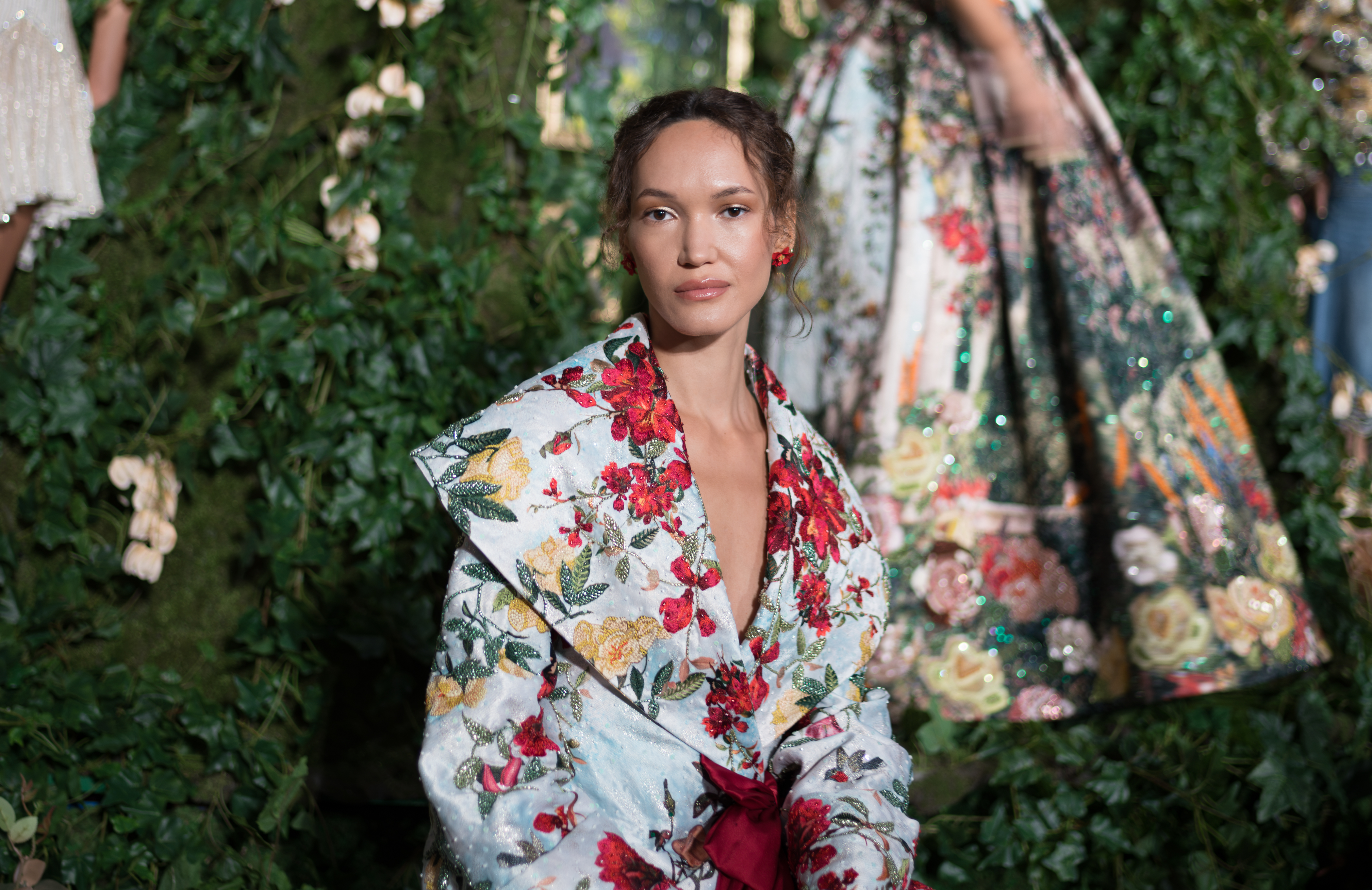
That duality found its most literal expression in the gowns, which ranged from a strapless confection embroidered edge to edge in red and gold roses, cinched with a burgundy sash and styled like a coat someone forgot to take off before the party started.
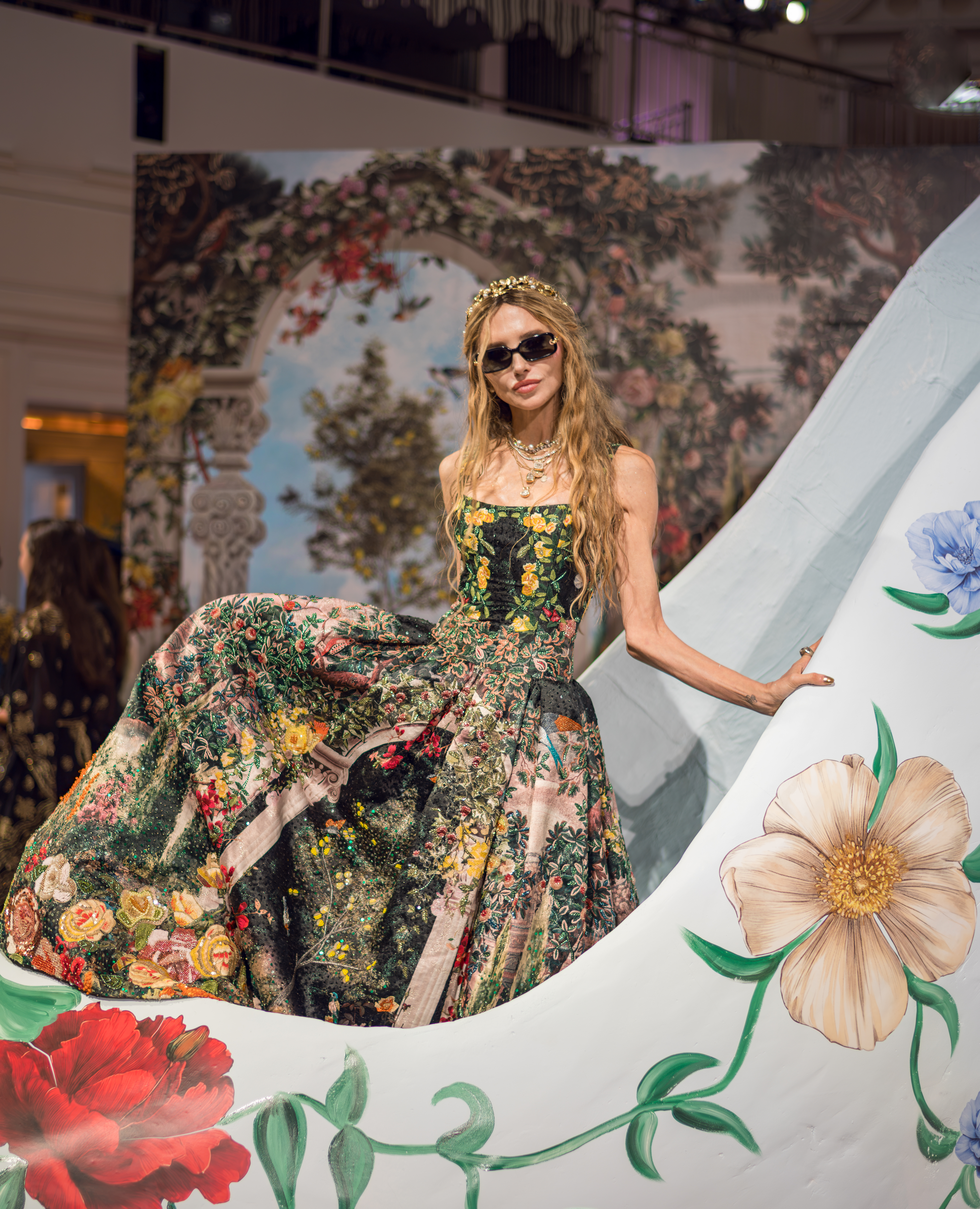
...to a full-skirted ball gown printed edge to edge in a garden of its own, dark and slightly overgrown, the kind of dress that seemed to have wandered in from a more gothic wing of the same fairy tale — sunglasses and a gold laurel crown included, just in case anyone mistook the mood for innocent, a reminder that this Wonderland, unlike Carroll's, always knew exactly how dark it wanted to get.
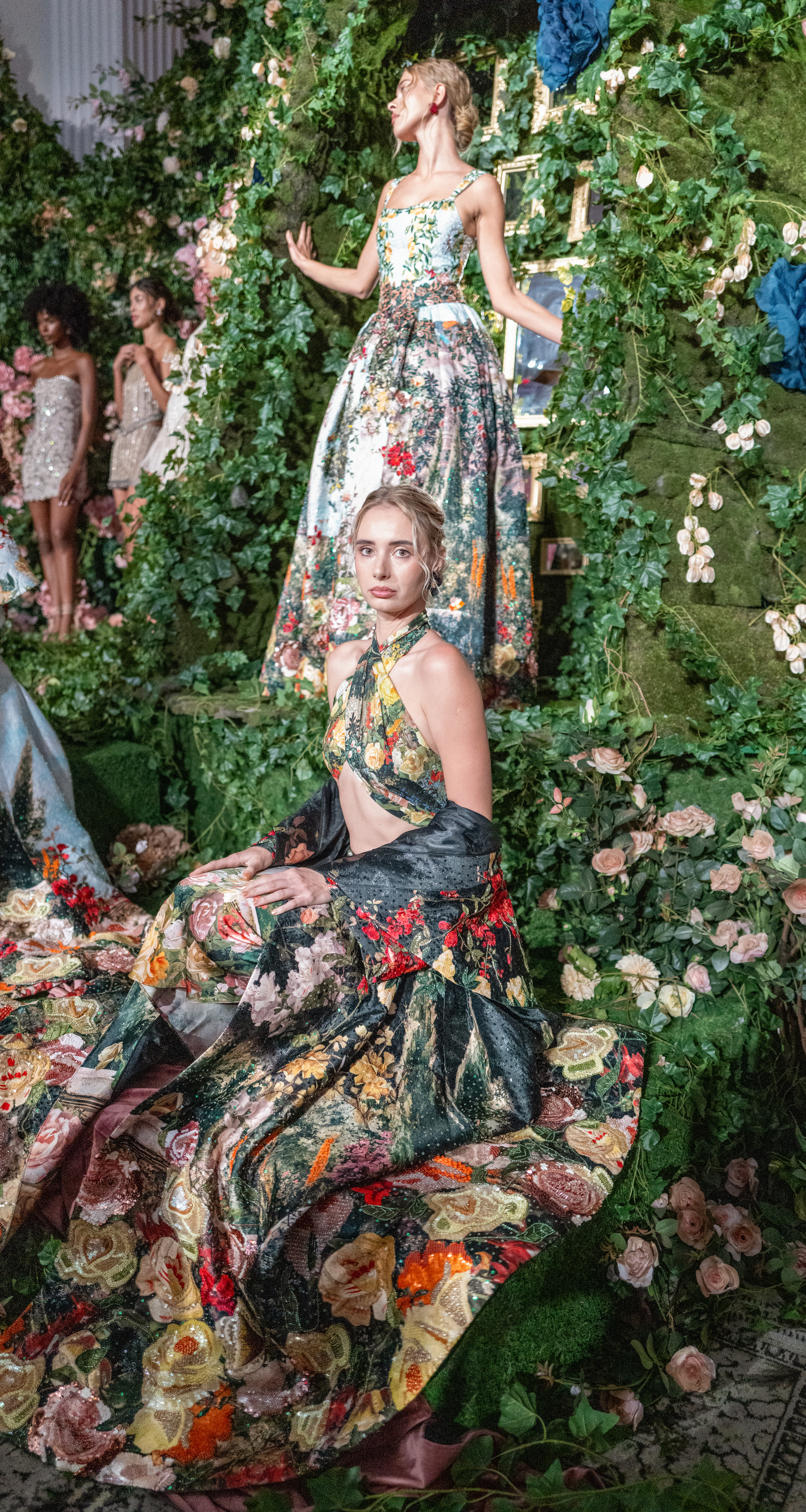
Two more gowns, styled back to back on the same mossy, rose-choked plinth, made the era-blending explicit: one in ivory florals with a corseted bodice, the other in a black-and-floral halter with a train that pooled across the artificial lawn as if it had grown there.
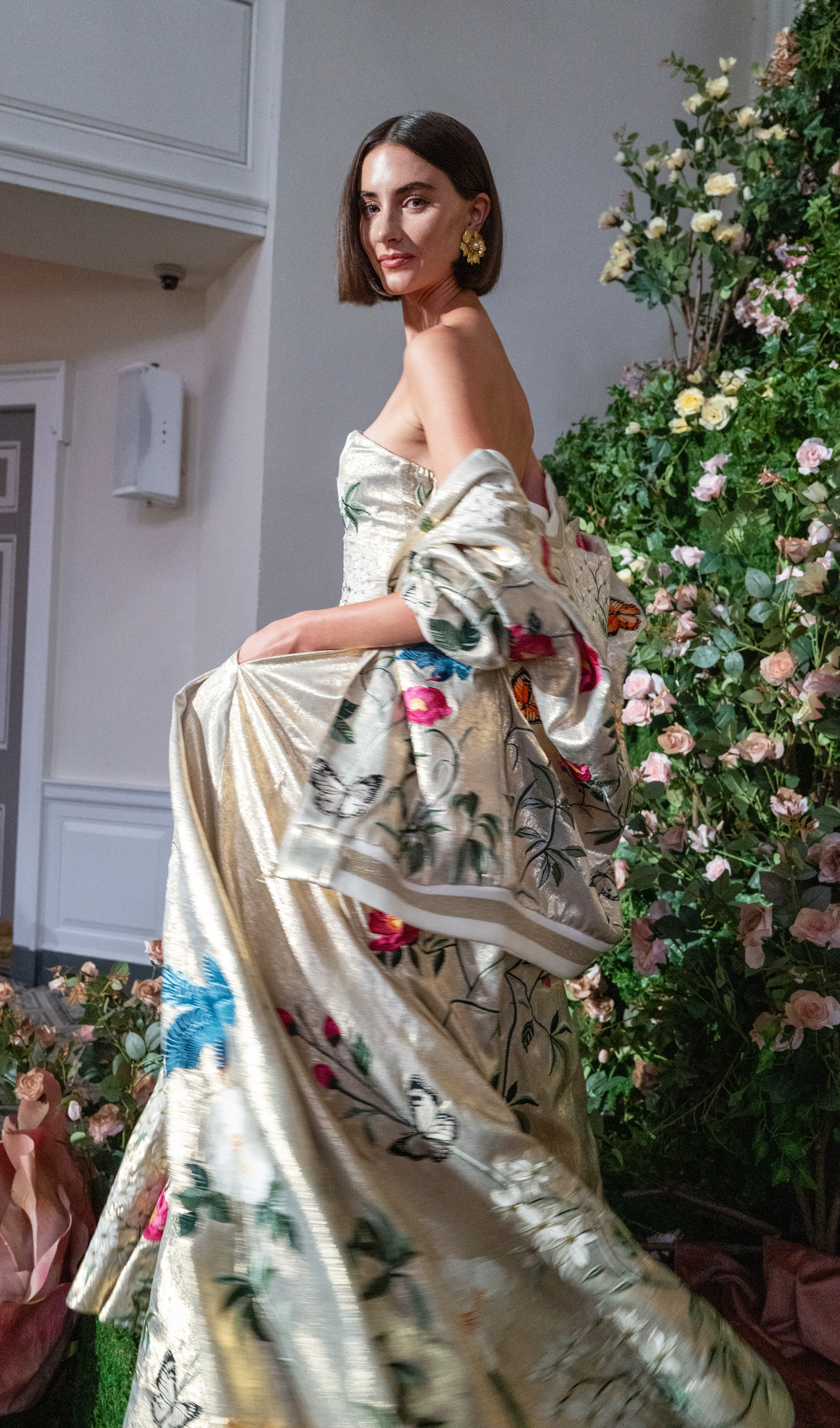
A third look, in liquid gold lamé painted with butterflies and trailing peonies, closed out the garden's more romantic register entirely, its metallic ground catching the light in a way no photograph, however carefully lit, quite manages to hold still.
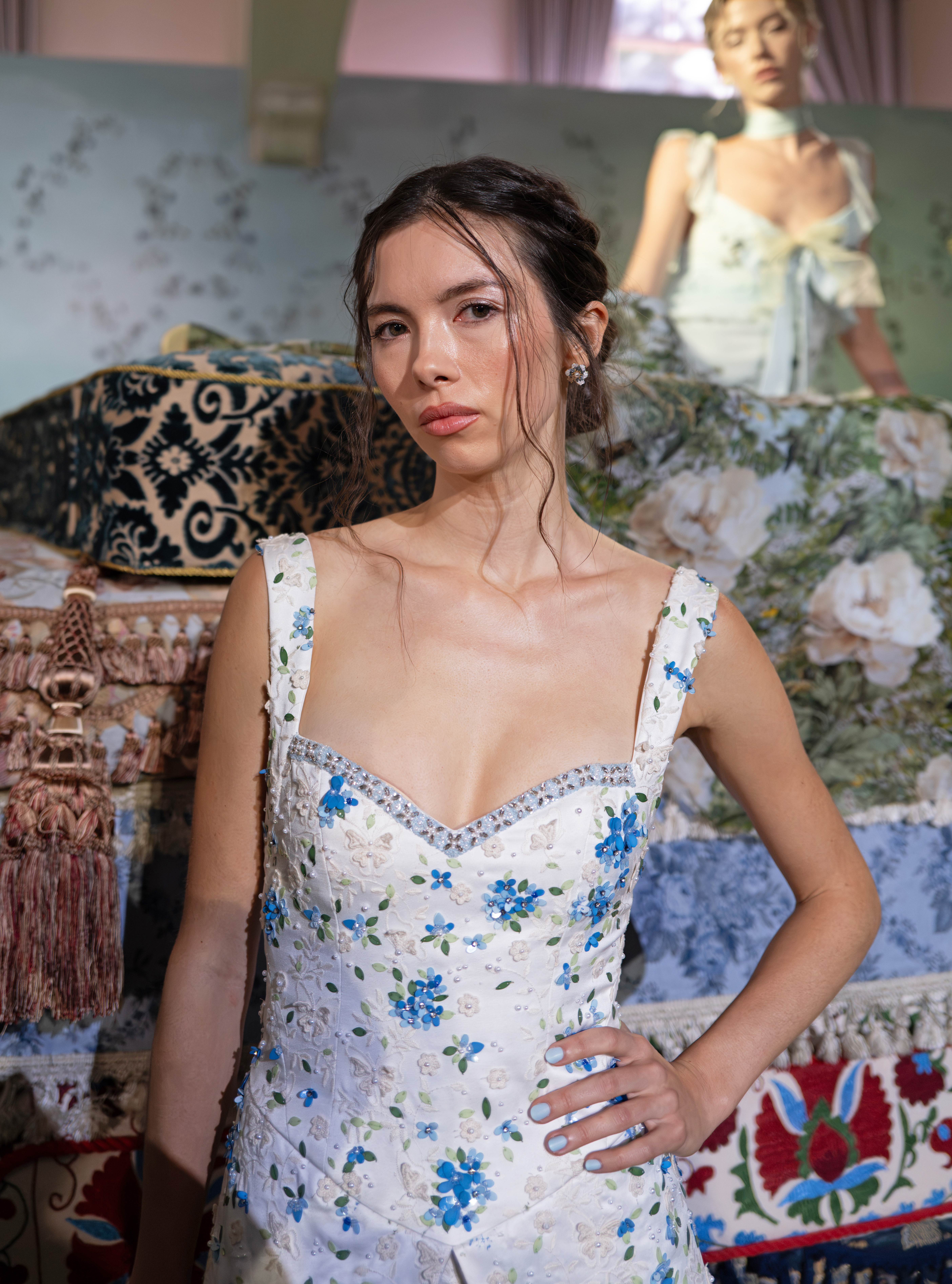
Even a close-up read as a still life: a sweetheart neckline picked out in hand-set crystal, a hydrangea-blue floral appliqué climbing the bodice as though it, too, had rooted itself there overnight, each petal finished in the same hand-beading that made the collection's embroidery its single most labor-intensive element. The other throughline, less romantic but no less telling, is Bendet's appetite for doing things herself, faster, and increasingly with tools that did not exist when she started. She has spoken candidly about now using artificial intelligence to iterate on embroidery designs in real time — "I will literally sit and play with all the embroidery using AI myself," she has said — collapsing what used to be a weeks-long back-and-forth with her design team into a single afternoon of her simply deciding: I want this.
A Study in Contrasts
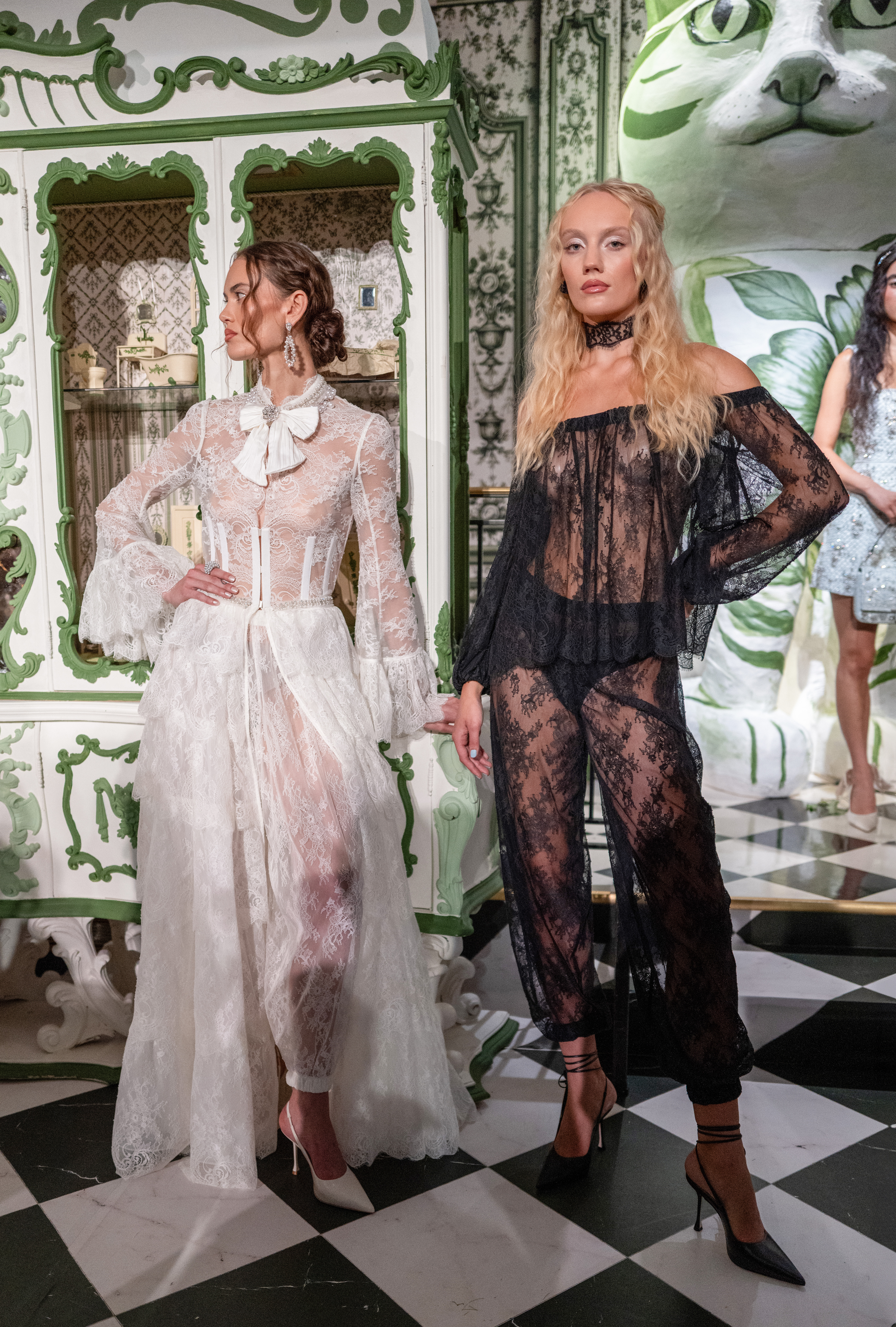
Not every room in Bendet's Wonderland was in color. One corner, dressed in a black-and-white toile print the size of a stage set, staged its own quieter rebellion: a caped, black-lace-trimmed dress over crinoline beside a sheer black lace off-shoulder ensemble, both finished with lace-patterned fishnet tights that read as illustration as much as hosiery.
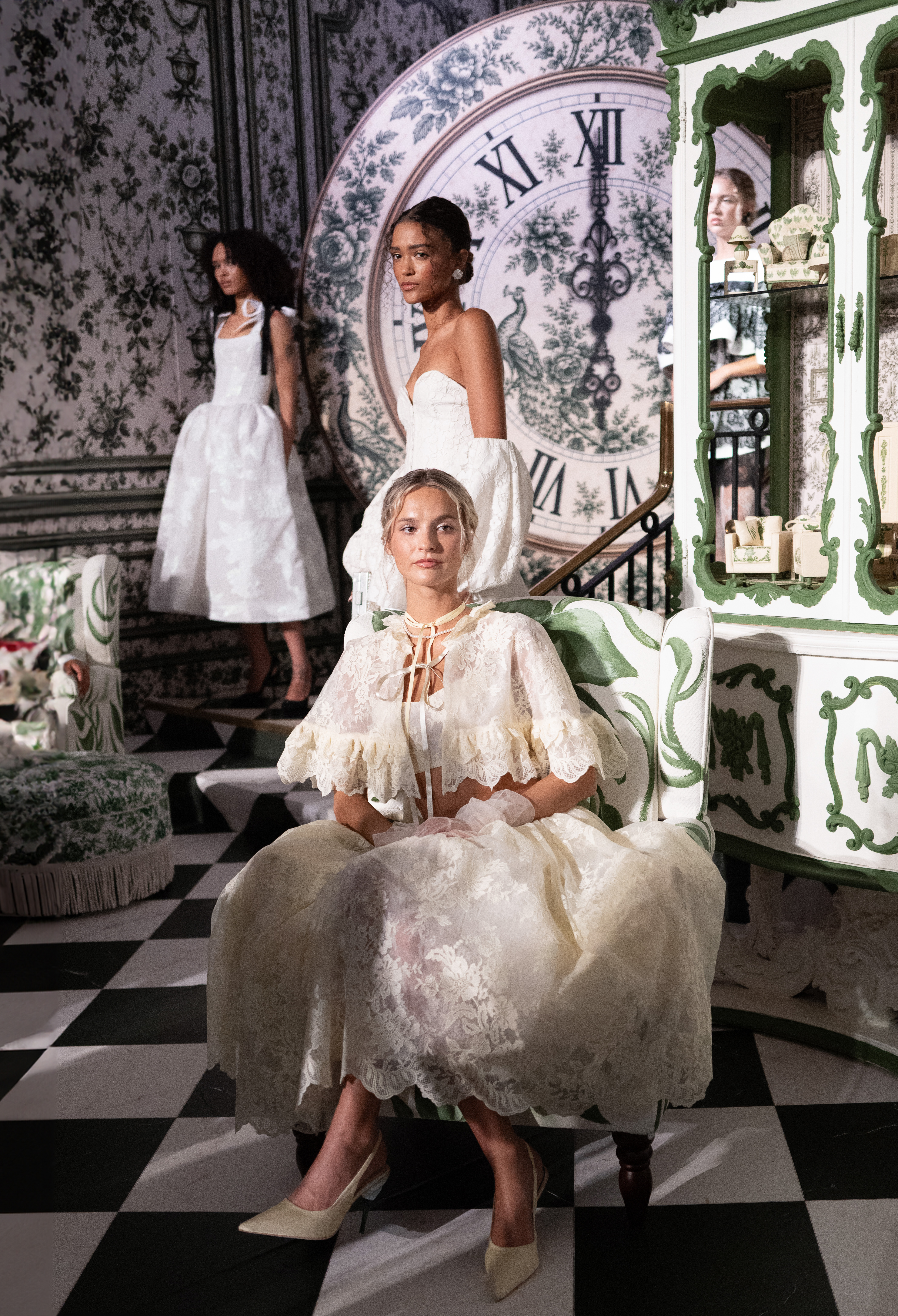
Nearby, in front of that same oversized painted clock, an entire trio arrived in nothing but white — lace, brocade, and antique-cream tulle, three variations on a wedding that never quite committed to being one.
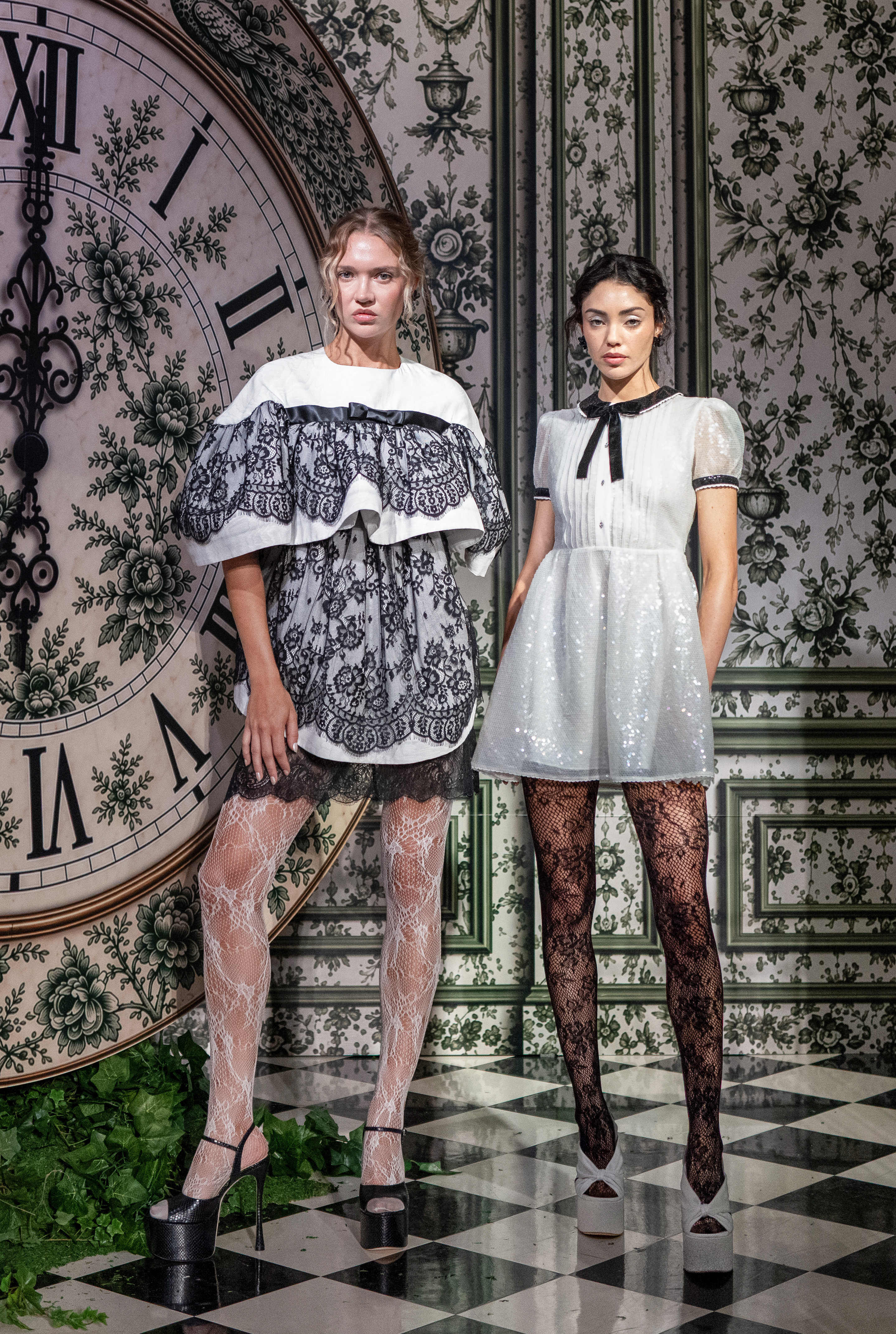
The clock reappeared a few feet away, this time keeping company with a strictly monochrome pairing — a lace-caped silhouette and a sequined party dress, both grounded by the same black-and-white checkerboard that ran the length of the room, proof the collection's palette could hold a single note as confidently as it held all of them at once.
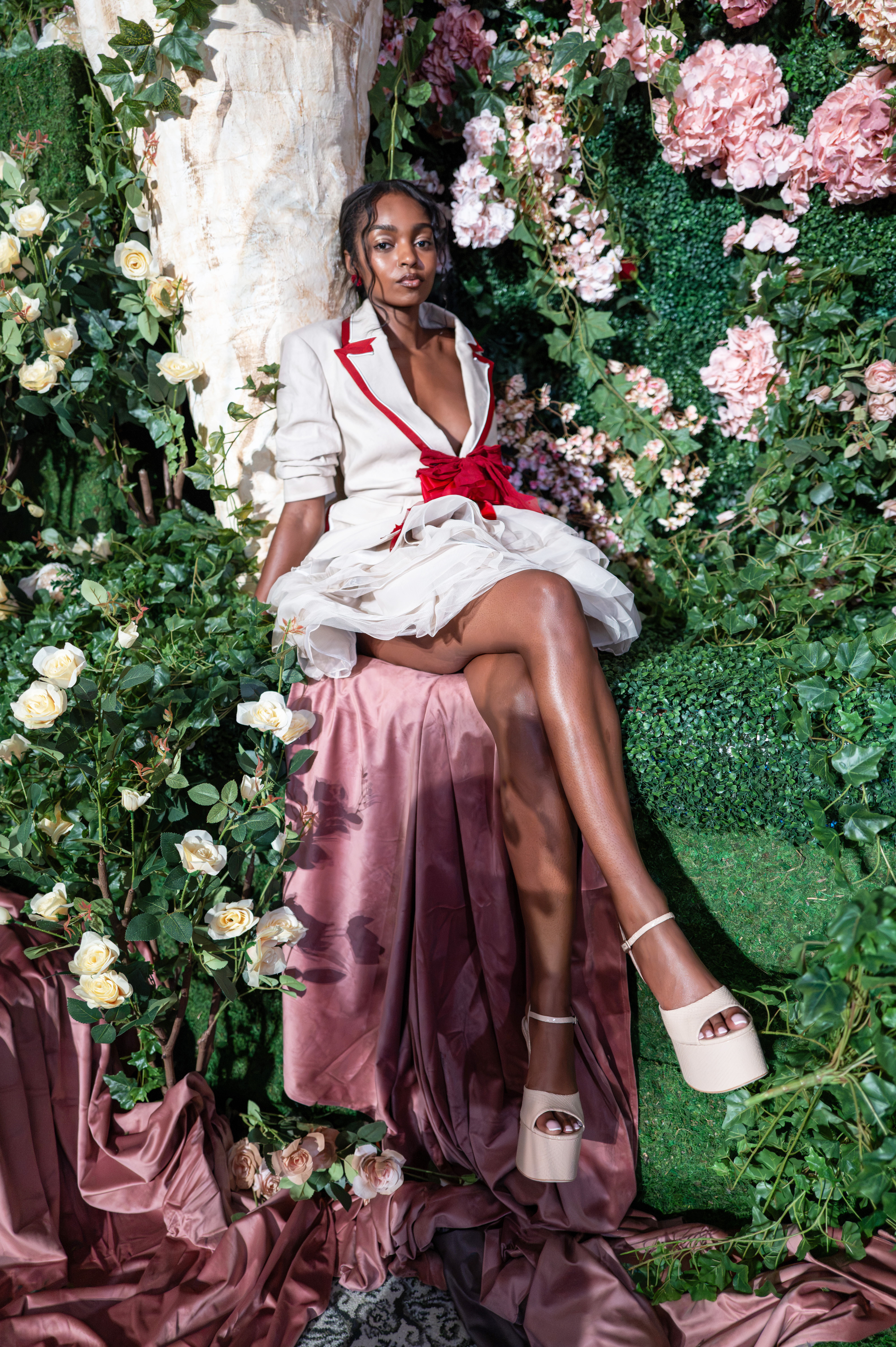
Spring 2027's stage happened to be a fever dream of teacups and topiary, but the underlying instinct — that a customer should be invited into a narrative rather than simply sold a garment — is the same one that got Bendet out of the gate in 2002. That instinct produced what she has called "the season of the dress," and Spring 2027 leaned hard into the description — a collection built around unabashedly feminine, theatrical dressing at a moment when much of the fashion conversation has drifted toward the deconstructed and the ironic. Bendet's answer to that mood was to double down on the opposite: more feather, more sequin, more organza, more Wonderland. It is a wager that femininity worn without apology is not a retreat from seriousness but a form of it — the same wager, really, that she made on those twenty pairs of pants back at the Russian Tea Room, just with better lighting and a bigger guest list. By the time a last model settled onto a heap of dusty-rose satin in a red-trimmed white blazer dress, roses spilling down the wall behind her as though they, too, had been sent an invitation, the point had been made a dozen different ways without once repeating itself.
Twenty-three years in, Stacey Bendet has never needed to reinvent Alice + Olivia so much as reaffirm it, season after season, in slightly more elaborate costume. Wonderland, this time, simply gave her the excuse.
Photographs by Bridgett Ezzard (@bephoto).